Back to the blues again today. There was a brief respite from the constant flow of blues there for a while, but now a homeless CD has served up some more blues for the hard-drive. Just going to get right to it.
So I have no idea about this CD or even really how it got out of its case. I may have tried it out, I think I would break out every tenth blues CD and try and listen to it before moving on in favor of something weirder or more dynamic.
I was getting so many CDs that the ones that stood out were the ones that were essentially something I had never heard before. The wilder the CD the more likely I would end up listening to it. If it was at all what I expected I would keep digging. And so a lot of these admitidly fine blues CDs ended up buried. The blues, while many things, is rarely surprising.
Apparently he's a Philadelphia harp man who studied under Muddy Waters harmonica player Paul Oscher. This is kind of pure Chicago blues, really. Shuffle beats, electric guitars, early rock n' roll sound to it some of the time--especially in We Gonna Ride. We Gonna Ride is of course one of two back to back songs about getting a new car. The second the more direct My New Car. There's still time, perhaps Snake Oil will be about a new car as well...
Guyger uses that distorted harmonica sound with his band heavy on the reverb, giving his band a 'dirty' feel. It helps evoke that smoke filled dive with watered down whiskey.
Rib Shack Boogie is a straight boogie rhythm while Steve and someone else talk back and forth about how good a bar-b-que smells. And then, apparently their plan to head to a chicken shack afterward, interspersed with solos. I'm going to decide this is improvised. Or perhaps it was something they put together to pimp the rib shack they were playing at and they just got into doing it.
I crashed iTunes trying to use Ping and now I don't know where I was on the CD...
Monkey on a Limb almost doesn't fit. Gone is the distortion, the guitar comping is fairly jazzy, almost a bossa going on. I actually thought that the CD had ended and iTunes had moved on to the next one.
It was entirely rare that we'd actually get box sets as promos. More often we'd get these sampler discs as promos for the larger box set. This one is a five CD box set for Arhoolie records themed around its founder and his journey looking for 'roots' music. As a result the music on here is pretty eclectic. So far we've traveled through blues, zydeco, and something in French. Now we're on to Mexican music. And now back into country blues, beat up guitar sounds like it was recorded on one mic country blues. Awesome.
I have a new favorite lyric, "If it was raining soup, I'd be caught with a fork peoples, tryin' to live in this mad mad atomic age." Another country blues, Lady Luck by Mercy Dee Walton.
This must be what it's like to be a booking agent for A Prairie Home Companion. Rose Maddox's folksy and humorous Single Girl would fit right in, as would all of this music.
I mentioned that this would be eclectic? We're on to Klezmer music. I'm constantly surprised at how much saxophone there is in klezmer music. I have no idea how that came to be. There's a Charlie Parker anecdote about him picking up a bar mitzvah gig while hanging out at Milton's that was portrayed in the movie Bird. I didn't really have any coming of age rituals growing up, but having Charlie Parker showing up at one would have been pretty awesome.
Sweet, straight up boogie woogie piano. I love boogie woogie piano but I don't have any. Well, I do now. Awesome. I wish it was more than just this one track. Boogie woogie piano is the kind of piano that I would want to be able sit down and play at an unattended piano, it's the kind of piano that I imagine would be the closest to causing spontaneous dance numbers. That and stride.
There was a short period of time where I was listening to a lot of ragtime bands and I have no idea now what brought that on. (what brings on this mention is the selection by the New Orleans Ragtime Orchestra playing Creole Belles. I think there was a snide comment that Willie "The Lion" Smith made on the album that went into the Albatross but I can't remember what it was. For a bit, though, I had a decent collection of ragtime band music. That's band music specifically, not ragtime piano, but ragtime bands. It went as mysteriously as it came. I don't dislike it in the least, it still sounds cool to me, I just don't listen to it...well, ever anymore.
This seems like it was the box set designed to fulfill my pretentious 'amateur ethno-musicologist' aspirations.
I certainly have a more extensive blues collection than I had imagined. This is the most persistent lesson so far from the project. I thought maybe I had hit a vein of blues and that things would start to balance out, but I think that it's time to face it, the Albatross is made up of a whole lot of blues CDs.
It's a party in my ears today, you're all invited...
Right off the bat, this is the jazziest blues album so far. This is closer to Joe Williams than it is Robert Johnson. This is not guitar heavy at all. It took me a moment to even identify if there was a guitar in there at all. There is a trio of saxophones and a trombone and a rather pervasive piano.
Of course as I write that, a lengthy guitar solo starts up. But not a grindy, gruff guitar solo, but rather an articulate, almost jazzy guitar solo with clean single lines.
The liner notes call it jump blues...I guess I could refer back to yesterday's liner notes for clarification, but I already don't know where they are.
As if to drive home the whole Joe Williams comparison, he's singing a song I associate with Williams, Don't Let the Sun Catch You Crying. I really love this song.
I haven't managed to find anywhere in the liner notes yet that explain why he's nicknamed "T99." Seems a little old to make a convoluted Terminator reference.
I'm finding that when I like a CD I sometimes have less to say. I feel goofy just going on and on about how 'this is cool.' I don't really have anything insightful to say about the blues, especially at this point since it's I think the seventh or eighth blues CD to have gone in.
Sweet Mr. Cleanhead might top the list of potential super hero names should I suddenly be granted super powers.
Winter & Winter became one of my favorite labels while working at the store. I never really knew who distributed them, or maybe I did and I don't remember now, but that German label was pretty consistently awesome. I just started to assume that cardboard and cloth case meant, "I was going to like whatever was inside."
Usually this meant some rather strange hybrids of free jazz and modern composition with the likes of Uri Caine (who Winter & Winter introduced me to), but this time it's in the form of a zydeco collection. German label, zydeco music...sort of hard not to start thinking about Schultz Gets the Blues. I don't really have anywhere to go with that, though. Except to imagine that a quiet, large, good natured German dude is playing all the accordion parts.
There was a brief flair up of zydeco love at the store when the main buyer opened a Beau Jocque CD that contained the lyric, "Get 'em Beau Jocque." It was hard not to get infected with that, really. Zydeco would be a hard music to listen to all the time...that's a lot of pressure to be this enthusiastic all the time. Even the moderately tempo'd Ya-Ya (sittin' here lala waitin' on my ya-ya...) or this rather ballad like Turn the Page (that borders on being a regular R&B song with accordion in it...) it's a pretty high energy music.
Okay, this is kind of awesome. Ah, I spoke a little too soon. I thought it was about to be a zydeco cover of Abraham, Martin and John. That would be fantastic. It's sort of making me unfairly disappointed in this soulful Motowny song with accordion.
Now we're back up to speed with Let's Say Goodnight. Feet Don't Fail Me Now is a tune I know from the Dirty Dozen Brass Band, now I get an even faster version of it with...say it with me...accordion.
There was an accordion in my house growing up. No zydeco music, though, so I never knew its potential outside of being an instrument to accompany bubble making.
Iko Iko, awesome. Terrance Sieman is taking the song easy, I'm used to more cookin' with people doing this song. But the energy that sits under the surface of all zydeco music makes this laid back take work rather well.
I may have a second form of music that makes the best covers. Right now I'm listening to a zydeco Tequila and I'm completely sold. Get 'em Beau Jocque! (who happens to be doing this cover...)
Another day, another bag, the same old Albatross. I'm back and the stack of CDs doesn't seem any smaller. I've found a bag of 'fresh' CDs, it seems, and there should be less 'failures' in this one. But just from the surface of it, it's also a bag I'm not entirely aware of. Both of today's CD's I don't really recall seeing that often if at all. I don't know how this bag (it's still in a paper bag, most of the CDs had been moved to a re-usable shopping bag) managed to survive, but now it's the second to be digested into the Project. Let's get to it.
Rizwan - Muazzam Qawwali
Sacrifice to Love
This is another Real World CD, Peter Gabriel's vanity world music label. I've talked about it before. We move from Africa to Asia for this collection of Pakistani music by Rizwan - Muazzam Quawwali.
I know next to nothing about what's going on, to be honest. Fortunately, the liner notes are intact.
Of course, the liner notes are a little sparse on the subject. This seems to be a Real World failing. These are the nephews of the renowned Nusrat Fateh Ali Khan who introduced the west to Qawwali music, essentially (from the liner notes) Sufi and Islamic devotionals. Musically it seems to rely on heavy call and response, lengthy flowing vocal lines and a diverse and driving percussion, though not really heavy. The harmonium is kind of cool. According to wiki (no thanks, Real World liner notes...) the music is supposed to be rather high energy to "induce hypnotic states both among the musicians and within the audience."
Maybe it's the harmonium working overtime, but I'm feeling a lot of similarity between this and Zydeco music. It's not just the drone of the harmonium sounding like an accordion (natch), the percussion and tempo kind of fit in, too. Zydeco doesn't really go for as long, flowing vocal lines, but otherwise, it's not entirely different.
These are some long songs, each over 15 minutes.
The liner notes have a weird quirk. On the translation of the third track (the lyrics are remarkably short for songs that go on for so long), it starts off with what the Qawwali is supposed to be. This one is called I Am the Dust of the Street of Mohammed. The discription contains a brief note on the piece, "A 'naat' - a song in praise of Prophet Mohammed, Peace Be Upon Him (PBUH)." It's that last bit that seems trippy, the acronym there. I mean, I'm used to hearing that following the mention of Mohammed, but I've never seen anyone put it down as just initials. I wonder what the story there is.
This was released in 1999 when the two artists that make up the group were teenagers, apparently. I don't have anything insightful to fill in that information, really. I think it just exhausts what I know about this CD.
Various Artists
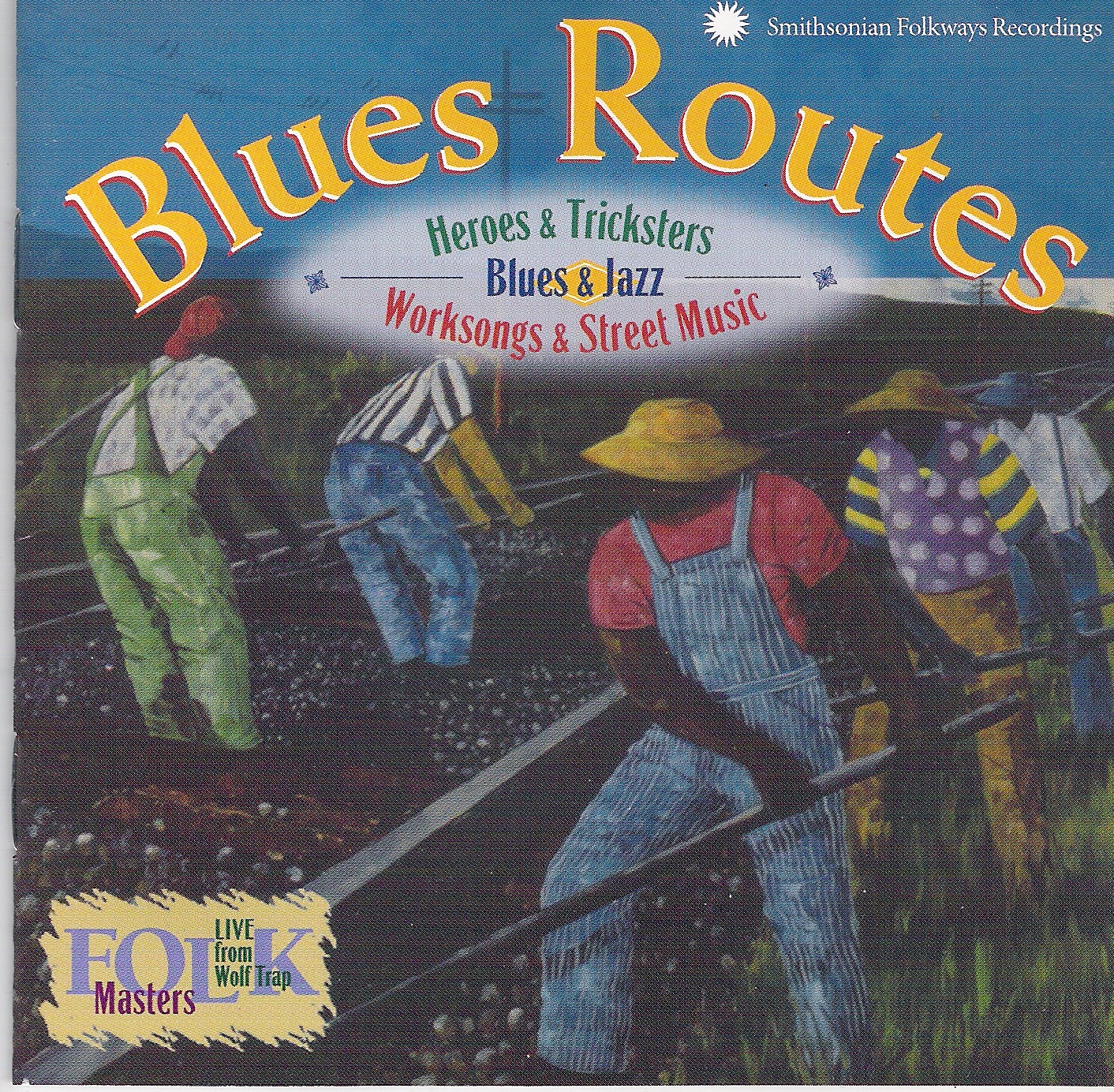
Blues Routes: Blues & Jazz - Worksongs & Street Music - Heroes & Tricksters
Well, another bag, more blues compilations. This is pretty interesting in that it's part of a Folkways series of concerts. Apparently it collects various folk permiatations of the blues in American culture. It started off with a raildriving song by the Gandy Dancers (Gandy Dancers apparently a term for railstraighteners for the tool manufacturer, Gandy...see Real World, those are useful liner notes...) lead by a guy named John Henry followed by the song John Henry.
Not that anyone can tell, but I haven't been writing much about this CD because the liner notes are actually fantastic. I've had my fun with some of the more over the top liner notes so far, and of course blues has been a leader in the field of ridiculous.
But these, these are pretty good. Each track gets its own little section where the style of blues represented is given a brief but clear introduction including what makes it distinctive, its history, development and place in the rest of the blues cannon. So while I should be winging my way through commenting on the music and searching the nooks and crannies of my brain to try and remember all of this stuff that I may not have known in the first place, I'm instead filling in a bunch of gaps, like the railroad thing at the beginning. Or the history of the banjo, which I never apparently knew.
According to the liner notes it more or less evolved from a stringed gourd instrument brought over by slaves from West Africa. When it became a common feature of minstrel shows mocking black culture it sort of fell out of favor for the guitar. I never knew that. Of course, I never really liked the banjo, but I should have at least known where the instrument came from.
This is another Smithsonian CD so I guess it shouldn't really be that much of a surprise.
I'm on to a recording of the Mardi Gras Indians, black groups that act as 'tribes' during Mardi Gras with elaborate costumes. It even gives a list of CDs that contain nothing but Mardi Gras Indian recordings. This is like the champion of liner notes.
Following that is a band with paint bucket percussion. I had the opportunity to interview San Francisco's own Bucketman (who will be the first to tell you that he's been featured in Pursuit of Happyness and various TV shows.) He's a pretty entertaining guy to talk to. Doesn't really relate to this recording, but he was fascinating to talk to. This recording is apparently an example of Washington D.C.'s go-go music, a sort of folk rap form using bucket percussion. Awesome.
This CD should come with a unit of American Music History. It's probably the most informative thing I've listened to without actually getting a unit or two in the process.
See, I didn't know there was a San Francisco/Oakland 'sound' to blues. But it's clearly awesome. Joe Louis Walker is quoted in the liner notes describing it as "more swinging, as opposed to th real hard Windy City shuffles. It's more of a swing jump thing --very danceable." Show all
But mostly it started off with some heavy slide guitar, which I love.
What I'm finding most is how much I remember of getting certain CDs more than I am how much I forgot about getting others. I think I remember getting one of today's CDs, while the other is a complete and total mystery to me. They clearly come from different places in my collection because they are in entirely different conditions.
Let's get started.
Barrington Pheloung Soundtrack to Hilary & Jackie
Every once in a while a promo gets taken home completely by accident. You're taking home a big stack of promos, and somehow one of these promos that's only in a sleeve slips in with them. You can't do anything about it, you can't sell them, they usually only have enough information on them for ordering when ordering was relevant, so when you discover them months later you really have no idea what they are or what to do with them.
I probably picked this one up on purpose, though, it's a soundtrack and it's a classical CD, so it was 'up my alley' so to speak.
Actually, as I look through the accumulated grime (this CD was still in its wrapper, so that was some persistent grime) it's actually mostly the work of composer Barrington Pheloung. I don't feel too bad, iTunes thinks the whole album is Elgar's Concerto for Cello.
I don't know very much about this movie. And by 'very much' I mean I don't know anything about it. Apparently it's a biopic about famous cellist Jacqueline du Pré from the point of view of her sister who wrote the memoir the film is based on. This explains the dominance of cello music and the inclusion of cello pieces from noted composers. The opening recording is by du Pré herself, the others are by Caroline Dale.
I've never heard of du Pré before, despite having a love for the cello. I'm not sure if I should feel ashamed of that or not. Apparently the movie was well received and nominated for two Oscars. What the hell was I doing in 1998 that I completely missed this?
It might have been right after I quit the movie theater where I had been a projectionist for a number of years. There was about a year or so I just stopped watching movies because for the previous years I had almost literally watched every major release to come out.
The music is dark and deeply emotional. The cello is really an expressive instrument. For a CD I really knew pretty much nothing about, this is kind of a treasure.
I was going to mention this on the Canadian Brass album, but there is something about classical music that makes people cough. I guess people cough at every concert, you can just hear it in classical. Even in recordings that don't appear to be 'live' recordings.
This provides a much classier soundtrack for the climax of Days of Thunder and this episode of Miami Vice, by the way. I don't know why I don't turn the TV off to do this. I have really good headphones, so I can't really hear it. I'm just used to having it on even if I don't particularly pay that much attention to it.
I'm kind of surprised that this CD has survived this entire time. To be as dirty as it was it must have been in some of the more neglected piles. I'm glad it did, I can always do with some good cello music. I might have to dig this movie up, it sounds kind of racy if not completely depressing.
Buddy Guy and Junior Wells Real Blues
Once again, I am completely stunned by the amount of blues in the collection so far.
There are no liner notes (disappointing for a blues CD, as I mentioned earlier) and I can find virtually no information on the CD except that it is widely available for download.
This is clearly a live recording, including his announcements to the audience and thanks to an unnamed sponsor for the concert. The first half is Buddy Guy who is joined on the second half by Junior Wells.
The instruments are recorded well enough, but the voice mic sounds like he was using a pair of headphones.
I've never heard a blues version of Satisfaction...interesting. Also, by the time this song started they have apparently improved the voice mic, it's not great, but it's better.
So far the Albatross has dealt up Chicago Blues, we just keeping getting older and older.
Well, the mic problem is back, which is too bad because I love Messin' With the Kid. Now it seems like they're running the guitar through the same amp. All in all this has a bootleg quality to it. But really, for blues, that might lend a legitimacy to it. Talking about the recording quality of a blues CD might be akin to complaining the seats aren't comfortable in a vintage sports car. This kind of recording gives it a kind of authentic feel. But the recording can't be that old that they can't mix it properly.
Well, we had a fade out on the last live CD, now we have a fade in. That's a little weird. I would guess that this is an anthology, but the recording quality is consistently poor. The copyrights on the back are 1994 and 1999. The CD was still in its wrapper. The performances are pretty good, obviously, and if you don't have a problem with that 'bootleg' sound, then you wouldn't have a problem with this.
I'm kind of floored at how little info I have on this recording. It's another short one, too, at 42 minutes.
Feedback even. Was this recorded in a school gym? This is probably the best known blues artists to go in so far and it sounds like it was recorded on a $10 budget.
Still and all, it's kind of cool not in spite of its flaws but because of them, in a very weird way. What could I expect for free, I guess...
I was never really aware of how much blues was in the Albatross or how little I knew about them. My pre-store exposure to the blues was wandering by blues bars, or the occasional blues festival.
I've also come upon my first non-music CD, and one I bought on purpose.
There's not much else to prelude, here, so I'll get to it.
Luther Allison Live in Paris
I'd be hard pressed to really quantify the difference between this CD and the last blues CD. I mean, they're both that kind of 'rock-blues' or "Chicago Blues" or what have you. But already I like it a lot better. It might be the live recording; I think that Blues works a lot better live in general. It might be that unquantifiable 'something' that separates good and great players. Maybe, and more likely, it's just a matter of taste.
My Babe was a nice take on a spiritual (I think) turned into a song about, obviously, his babe.
This might be the first time I've heard someone other than B.B. King do The Thrill is Gone.
The liner notes on blues albums are fairly over the top. I mean, all liner notes tend to have what my Aunt called "purchase reinforcement." I mean, you've already bought the CD and now here's three small pages of some dude gushing about the artist you've already purchased. It happens a lot in jazz, usually by some jazz critic who spends the first few paragraphs patting himself on the back for being so clever as to be a jazz critic. Then there is a few paragraphs about all the super cool jazz artists that the critic is also into. Then some biographical information about the artist wrapped up with some high-toned notions about the artist in the grand scheme of the universe.
But blues liner notes takes the whole thing to another level. They drip with pathos. The back of this album has a great example:
In 1979, the blues took the features of a face, that of Luther Allison. The primary value of this recording, his first live album, is to make one feel Luther Allison's musical abilities, as well as the intensity and generosity of his live performances. You can also find the memories of the privileged moments - maybe a few seconds when you feel, when you know, that Luther shuts his eyes and opens his soul. At that moment, his guitar no longer speaks to you, it cries and its tears are blue.- Jean Cabot, Rock and Folk
The color change is part of the notes as well.
The blues lives in large part on its mythology. Music in general lives on its mythology, really. But blues wallows in it. More often than not, the technical ability of the performer is a back seat rider to their 'feel' or sound or the general nature of their state of "blues." Kind of like rap, you have to legitimize the blues artist before anything else. It stands to reason, I guess, being a music based on a state of being in the first place.
The music is good. I feel like I should mention that. Nothing is reaching out and demanding I comment on it. Since it's a live performance the solos go longer, though damage to the CD has eaten the length of at least one of the tracks. Wait, there's actually a fade out on one of the tracks on a live recording? How does that work?
Bill Hicks Relentless
The internet loves Bill Hicks. I'm not really going to be able to come up with something new to say about him. Or at the very least very insightful.
Even with all the love for Hicks, it's pretty weird to listen to topical comedians way out of context. He's opening his show (after berating his eager audience) with a bit about Clarence Thomas' conformation hearings.
Hicks is one of the Martyr Comics, comedians who have died for our sins. (The blues liner notes have infected me...) Usually it's comedians who focus on social commentary (more so than comedy naturally does). And usually huge advocates of recreational drug use. Lenny Bruce, Sam Kinison, Bill Hicks, most recently Mitch Hedberg. If you add comedic actors, I guess you could add Jim Belushi, Chris Farley, and Phil Hartman. But those I think fit into a different category (former SNL cast members who died early?)
I actually didn't remember Hicks at the time I bought these CDs. At some point the label re-issued Hicks' catalog and I ended up getting fascinated by it. I bought into the packaging which had billed him as a modern day Lenny Bruce, Martyr Comic and all. I've always been fascinated and a big fan of stand-up comedy. It's absolutely clear I would be god-awful at it, so I form an academic fascination of it. And so the cover of the CDs convinced me that Hicks was a comedian I should know and I bought the entire catalog.
After listening to his CDs, I found that I did remember him, just didn't know his name.
It's weird to hear a Chuck Norris reference that's actually timely and not ironic.
Relentless has the often repeated bit on drugs. Occasionally an anti-drug ad will live beyond its intent and become the favorite of the drug crowd, from Reefer Madness to the "This is your brain" ads Hicks is riffing on now.
Listening to Hicks, I start to see the genesis of some of the prominent internet forum attitudes. Hicks' developed an arrogant-informative style where he belittles the counter-proposal of whatever his idea is in the presentation with a clever cadence and sneer that feels like it comes out of the side of his head. Like many imitations, the forum version often falls short--not to mention the sneer is hard to pull off in text.
Certainly hard to do the snorting sound effect of Rockers Against Drugs 'sucking Satan's cock.'
I heard someone comment on a show about comedians being frustrated rock stars. Wiki has a thing about Hicks' relationship with Tool, whose lead singer apparently used to be a stand-up comedian, too. To drive the notion home, Hicks ends Relentless with the song Chicks Dig Jerks. After the internet and its forums, this idea has become threadbare for me. Too often it's the lament of some noodle and 'jerks' are the people strapping on a pair and actually asking the object of affection out. I'm not the latter, but I'm not going to blame them for my own shortcomings.
Today is representative of just taking CDs home because I could. I knew I had to have some Nat King Cole and I in theory liked the blues, so home came these two different CDs.
This mentality is the chief contributor to the nature of the Albatross. I don't know if I ever honestly had the intention of listening to either of these CDs, but they were free and I had plenty of space in the Bus, so home they went.
There have been culls in the past, and somehow neither of these CDs were removed regardless of not having listened to them or even having the honest intention to do so. How could I get rid of a Nat King Cole album? And I had no idea what the blues CD sounded like, and didn't have the time to listen to it, so it got a stay too.
Well, today the CDs are redeemed as I at the very least give them the listening they deserved years ago.
Right off the bat, I'm stunned at how many of these CDs are expensive now. This one new is almost $40, used $10.
This is a live broadcast of a radio program, apparently. There certainly isn't any of that "24 bit remastering" going on here. The recording is presented hiss and all, with all the clanking and chatting of the attendees in the background as well.
Wait, I have to stop here and make sure I just heard this set of lyrics right...
"Baby let bygones be bygones / I'll punch a hole in your nylons / because if you can't smile and say yes / please don't cry and say no."
I'll admit, I'm a little disturbed.
Anyway... this also has the announcer on the recording, something I looked for in my collection. I've been mentioning this and trying to figure out exactly what it is I expected to do with the recordings that had narration on them... honestly, I don't know.
The Singles buyer at the store would make mix tapes of top singles for in-store play every now and then, but, even better, he would make 'mix tapes' for other workers and each one of them was coveted. He had a knack for taking other tracks and mixing the music and sound effects in fairly awesome ways. He was doing mash ups long before the internet made me aware of them again. I'm not going to say 'before anyone else,' just before I knew of anyone doing them. The hands-down favorite was when he took the Star Wars book on tape from the moment Luke Skywalker destroys the Death Star and had that fade into the song Cocaine by JJ Cale. I have to admit I do pale imitations of those mix tapes now when I make a CD for someone, but his were absolute master pieces. To this day, I can't watch Star Wars without humming Cocaine at the end or hear Cocaine without thinking of Star Wars. So I guess my obsession with gathering these announcers was to emulate the master of mix tapes, our Singles buyer.
There is no drummer in this trio, just piano, bass, and guitar. It's pretty much as you'd expect, Cole's voice is smooth and pleasant, the playing good. A trio of this nature doing the usually bombastic Basie piece One O'Clock Jump is a little strange. He repeats My Sugar is So Refined and Oh But I Do...I wonder if it's because he feels like no one is paying attention anyway - you can hear the crowd noise picking up in the background. A ringing cash register has become the replacement percussion.
I find myself trying to pick out conversations on the headphones, especially during the instrumental parts.
Right off the bat there are two flags while I wait for this one to download. First, I'm always a little uneasy with blues artists who want the blues. I know this is an ambiguous point, but I prefer my blues to be a completely shitty situation that the singer doesn't want but what can they do, they got the blues right down to their bones.
Second is the Flying V guitar on the back cover. I can't help but associate that with cheese ball rock from the 80s. Let's see how this goes...
Well, after the initial fake out of the opening of the title track that, for a moment, led me to believe that it was going to be just him and the guitar, which would have been awesome, the 'big blues' sound isn't that bad, really. No horns so far, but a big Hammond B-3 sound and drums that are too closely miced.
There's a nice write up here in the liner notes, about McCray working the GM assembly line in Michigan while playing blues on the side before he 'made it', from Niles Frantz of WBEZ Chicago/FM...the station that This American Life comes from. That doesn't really have anything to do with anything, except now I have a kind of nerdy Ira Glass in my head telling me hard knock stories of the blues. I have to say, awesome. I would pay good money (or bad, I don't care) to watch Ira Glass, Bluesman.
See this is what I'm talking about, I Feel So Damn Good (I'll be Happy When I Got the Blues). I mean, I get it, he's so used to being down that he feels uncomfortable feeling up, but it just doesn't have the same pain-induced ring of someone down wanting to be up--fantasizing about driving big ol' Cadillacs instead of fantasizing about when he'll be bummed again. I guess there's a chance he spent a fair amount of time building Cadillacs, sort of would suck the joy out of that...
All in all, this kind of blues, the self labeled 'rock-blues,' takes too much pain to mention the blues. I Was Born to Play the Blues, I Feel So Damn Good (I'll be Happy When I Got the Blues), Same Old Blues, Worried Down with the Blues. Blues has never been shy of putting 'blues' in the title, but in rock-blues it always seems forced.
An interesting reversal from Stormy Monday, considering that Monday is going to be the traveling bluesman's day off after he gets paid, so it's a Sunny Monday. Nice take.
I'll grant that my 'complaints' amount to complaining that it's not exactly the flavor of Ben & Jerry's you like...it's still pretty good. If they were playing at the bar, I'd buy another beer and hear their second set.
One of the things you can hope for from this kind of blues albums is a good road song, and I Wonder is shaping up to be one, with it's opening guitar figure. That's key to a good road song, a good opening figure.
I like these little shifts that happen in the narrative, "You made me turn my back on my very best friend / and while my back was turned you were messin' around with him." I'm sure there's a term for that, where one turn of phrase is then turned to mean another one. I just don't know what it is, I just like it when I see it.
Awesome. Twice I dated a woman across a river, I could have used a song called That Woman Across the River...
I like it when the day's random selections have something line up, like songs about shoes or in this case, sugar based puns in songs about one's 'baby.'
My pretension was that my music library would constitute some sort of music appreciation class. I have to admit that I envisioned it as some sort of musical equivalent of some well-read professor's den full of 'must reads.' That I would be able to walk to a section, I guess tobacco pipe in hand, and pull from some shelf and be able to remark on that moment in musical history or the importance of this particular influence or how interesting so-and-so incorporated such-and-such.
In short, I was privately plotting to be a complete bore at best and douche at worst.
I don't know why I wanted to do this. I can see people's eyes glaze over when I try to explain to them how music works or why they like the stuff they like or the development of this or that. Hell, I sometimes get bored myself. I don't throw parties and if I did I couldn't just put this stuff on random and expect anyone to stay (or at least commandeer my stereo).
Perhaps I'm living that fantasy by blogging the collection. I get to say all the 'smart and well considered' stuff about the CDs to almost no one (thanks to those that are reading), get it off my chest.
It's personified most popularly now in the Hipster's Dilemma. Alright, as far as I know no one calls it that and there probably is something else called that, but I don't feel like googling. For the sake of my argument, here is the Hipster's Dilemma: You've stumbled onto something fucking cool. It has changed the way you look at and consider whatever it comes from. Well, it's no fun to enjoy it completely by yourself, but the people already into it are way ahead of you. So you have to hip other people to it. But if that happens too often, now there are too many people into it and you're just one of the crowd.
I'm not really all that concerned that I'm going to hip 'too many' people to abrasive jazz or obscure CDs that didn't sell when they had the chance. But the first half is true. It's no fun to dig something all by your lonesome. You need that acknowledgment, this is awesome. Recognize its awesomeness.
Which travels a little bit from my original point, which is that very infrequently does the Albatross present itself in a manner that allows for that 'music appreciation' way. Except today, where it has served up another Telarc Blues release from a half session/half lead act, and a folk legend.
Essentially being represented are the two co-existing folk forms of the American 20th century played back to back. This is awesome...dammit.
Terry Evans
Walk That Walk
As much as I made of the universality of the blues in the last post, the truth is you really don't know what you're getting when you get a blues CD in the same way you wouldn't if it simply said 'jazz' or 'rock.' There's Chicago Blues, Delta Blues, there's blues that sounds suspiciously like rock (or rock that sounds a lot like blues), there are singers happy about getting the blues, there are singers seriously bummed out by the blues. There is blues that you dance to, there is blues that you tap your feet to, there is blues that you cry in your beer to.
Sometimes the cover can help you out. For instance, a lone bad-ass lookin' guy standing in something representing travel like a set of train tracks or an empty road, you're likely to get a band. It will be a little less rigid on the whole '12 bar' thing...it'll be the electric, and the singer is likely not to be happy about the blues.
According to what I was able to salvage from the liner notes, Terry Evans plays on a lot of other blues players albums and then has a handful of his own. Despite the guitar case on the cover, he only contributes guitar on a few songs, the rest of the guitar work handled by Ry Cooder, apparently returning the favor for Evans' appearing on Cooder's albums.
The truth is that I wasn't exposed to much actual blues early on. I found blues in jazz history classes where we discussed the influences and foundations of jazz. As much as I loved all the jazz I discovered in those classes I kept thinking, "No, wait, that was awesome, too...why are we spending so little time on it?"
So I used my promo-gathering as a chance to fill the gap. But since I didn't know as much about blues as I did about jazz, I grabbed everything and hoped to sort it out later. Welcome to later.
The problem is that the barrier is sometimes a little lower with blues, and as recording got cheaper a lot of people who managed to learn the 12-bar format recorded. So my blues CDs are a bit of a minefield, which made me a little gun shy to go through them.
I've already mentioned I love the lyrics in blues. So much has been said about them I'm not going to find something new and clever to say in general, but some of the stuff here is awesome. The title track really breaks down apparently to advice on what kind of shoes to buy and what to do if they're not optimal. Ultimately, don't get shoes that are too tight. Apparently. Good advice.
Dance With Your Belly Up is described at the end of the song as holding your baby tight and letting her know it'll be alright...then sort of dancing with your belly up. He says he was sure that the listener didn't know how to dance with your belly up, and he was right. Still not entirely sure. When in doubt, assume they're talking about sex.
A blues about credit cards that kind of feels like a School House Rocks element closes the CD. It almost seems like the theme song to credit reform. I wish I had been packaging a news piece and knew I had this. Pretty cool. Even has a lyric about pre-approved cards and everything. "Get you to sign that big contract / that's when they kick you in the sack." Awesome. "Credit Card Blues, gonna be in debt until they lay your body down." I guess it's kind of a middle class complaint by blues standards, but still cool.
Pete Seeger
Headlines and Footnotes
Another unwrapped CD, but this time I think it's because I intended to give this one to my friend and collaborator (you can see some of his work under 'sous rature' on The Sandwich Machine). He had gotten into Woody Guthrie and 20th Century American folk music and this was a pretty good collection. I may have gotten a few of these, so I don't know if he ever got one. I guess if he hasn't I can give him this one.
That's not to say that I don't have a fascination with this kind of music either, but he knew (and still does, I think) a lot more about it than I did. From a musical stand point it pretty much just 'is.' Often they just took traditional melodies and wrote new words over them. It is more important from a cultural anthropology stand point than a musical standpoint. That interests me a great deal, but I was behind the curve on it.
In an awesome moment of symmetry the album opens up with a song about shoes. I dig it.
There's a song about a senator named Bilbo (not a song about Lord of the Rings...) scolding him for his xenophobic policies. "Listen Mr. Bilbo, listen to me / I'll give you a lesson in history / listen while I tell you that the foreigners you hate / are the very same ones that made America great." Could sing that song now, except of course the song's subject would confuse people I guess. "Bilbo Baggins is a racist? Ah man..."
There's sort of a working class journeyman ideal image I had of him but, I'm reading in the liner notes, he had intended to be a journalist and was traveling with his musicologist father collecting songs and he caught the bug. He dropped out of Harvard and started playing. The academic turned folk singer is probably more common, I guess, and it makes sense when you consider the commentary in his songs, accented here since it's a collection of topical songs, but it does kind of deflate that romantic image. Of course the movie Face in the Crowd does a pretty good job of that, too.
I have a few of these Smithsonian Folkways collections and I liked them a great deal. They essentially cataloged the first century of American recorded music that otherwise would have been lost.
Listening to this CD is like getting short three minute history lessons in stuff where by the time you go "Wait, what happened? That's fucking crazy, when was that?" there's already another song about another crazy thing that happened that you suddenly want to know more about. This isn't folk music about friendly dragons or spinning in fields. Oh hell, as I'm typing this, a song from the point of view of a seven year old who was evaporated by the bombing of Hiroshima. Yeah, this can get pretty depressing.
From what I can gather from the liner notes, Seeger never stopped gathering music after the trip with his father. Taking poems and other written works and bringing them to a wide audience and helping convey their issues with a musicologist-meets-journalist's ear.
Little Boxes, the song not about weed that is associated with weed now because it's the theme to Weeds, is on this collection. I had been told this before but I didn't believe it, apparently the woman who wrote it (Malvina Reynolds) really did write it about Daly City, CA, which in fact looks like a bunch of little boxes from the freeway.
I have to be honest, I'm not used to paying this much attention to the lyrics, but I'm afraid of missing something important. It's completely opposite of how I usually experience music, where I start to tune in if the music hooks me and then I find out about the lyrics.
He actually explains Guantanamera, turns out that's kind of depressing, too. "With the poor people of this earth I want to share my fate / The streams of the mountain pleases me more than the sea." Apparently the last poem of a Cuban revolutionary before he was killed in an aborted uprising.
I also tend to think of his time as being older, but there's a song about the Women's Movement in 1971 (cleverly playing off "There Was an Old Woman Who Swallowed a Fly"), an anti-Vietnam song that can be applied to any quagmire situation, and a song anticipating the images from the first space flights.
Also, didn't know that The Lion Sleeps Tonight was on top of another song altogether. The whole Wimoweh thing is a South African song more or less about a king coming back to liberate his people. The Safaris (that 's what the liner notes say, Google disagrees...the Surfaris were a surf band, this song was first popularized as The Lion Sleeps Tonight by The Tokens according to the internet) just sort of co-opted and, as the liner notes put it, 'trivialized the song' into the one that we know.
An unexpected way to end a collection of folk songs: a breakdown of the science of the solar system and how it will come to an end, then an ode to his grandmother's culinary improvisational technique.
This is the kind of music you have to listen to with your finger on the Google search bar and a quick draw. The musicologist father has a lot to be proud of in his folk singing son.
Double digits, should be a milestone of some sort. That means that today will mark 21 CDs from the Albatross processed onto the hard drive.
I've also plugged in the scanner so that I can include the artwork for at least the cover. The blog looked a little drab, plus now you can see what condition most of this is in.
The first of the blues CDs has come up, as well as the organizational issue. It's getting closer and closer to the time that I have to decide what happens to the CDs once they've been transferred. I'm no closer to a conclusion. In fact, I've put no more effort towards it than has been witnessed. By that, I mean, I think about it while writing the intros, write down that I'm concerned, and then do not revisit the idea again until a few days later while writing an intro. Safe thinking - only acknowledging a problem when you're safely involved in something else and cannot address it. I live by that...
Anyway, onto the music:
James Cotton, Billy Branch, Charlie Musselwhite, Sugar Ray Norcia Superharps
I just got done talking about the phenomenon of 'super bands' and it seems to have popped up again, except in a different way. Every once in a while there is a 'super band' that's actually just a gathering of notable performers on a single instrument. That's what Superharps is, a gathering of four exceptional harmonica players.
Harmonica is a tricky instrument. It can either be an awesome sounding blues/folk instrument or a grating tool of annoyance by that bastard in the corner who won't shut up. Obviously this is the former. It's easy to kind of get lost in the blues. I mean, largely it's that same progression of chords (it's even called 'the blues progression), even if people don't necessarily religiously follow that, it certainly can run together.
But aside from the progression, it's got lots of other cool things with its name on it, things like 'blue notes.' There is just something about the sound of the blues that transcends its repetitive chord structure or iambic lyric structure. (I'm really hoping that I come across a Bernstein CD I have that has on it a demonstration of blues' iambic pattern by turning a line from Macbeth into a blues song. It's predictably awesome.) Something that makes it infinitely listenable.
This must have come in a narrow period at the store, because we had an avid harmonica player that worked there and I'm surprised that I have this and not him. I think there was a period where I worked there and he didn't and this must have come in during that time. Or it just went in a box and since it said "Telarc Blues" (Telarc is the label) I wound up with it and the poor harmonica player got shafted. Too bad, because it's a pretty cool album.
Even with good harmonica it's hard to find people who don't overwhelm their microphones so much that it doesn't really matter what they play or people who just hyper-ventilate into the poor thing. Or both. All the familiar harmonica flourishes are here, but it's distinguishable.
This is the kind of music that makes you want to drive around in a patina-covered old American convertible. Like a Bonneville or Cadillac or Buick. Ah, as if to hammer that home, they play Route 66. Perfect.
These may be the most succinct and perfect narratives available. They state the condition, restate the condition for clarity, identify the cause, and then let you know the consequence. All in three stanzas.
I read enough comics as a kid (and adult) to automatically associate 'super' with a hero of some kind, so staring at the comic style cover I imagine a traveling quartet of blues harpmen who also fight crime with their blues-like super powers. I don't know what those powers would be, but I'm sure they'd be awesome.
I'm also wondering what it is about the name "Ray" that attracts the prefix "Sugar." A "Sugar Ray," while I'm on the subject, would be an awesome super power. Again, I don't know what it would do (sweeten drinks from a distance? Beam some lovin' in a concentrated blast?) but I'm pretty sure it would be awesome.
For the most part this album has been trading back and forth, one or two performers on each track. Of course, you have to go out swinging, so there's a full-on easy groove blues at the end that's all four of them that goes 11 minutes. It's this kind of open ended jam session all comers thing that's part of what makes blues so awesome. Especially when you're there.
You're taught jazz by cool old men. Sure you might run into or have a hip young cat teach you some things, but it's only a matter of time before he (or she) introduces you to the cool old men that taught him, that he learns from. And one of the things that cool old men that teach you jazz will tell you, is that everyone likes jazz more than Americans even though it was born here.
Because of this you get cool Finnish orchestras performing some incredible Miles Davis tunes, broadcasting union orchestras stretching to find the rare charts in the Ellington library, and Japan releasing new albums from hot young jazz talent.
I don't really know who the cool old men who taught James Carter to play are, but they're probably the ones who told him to check out Japan. (According to his website, Marcus Belgrave).
James is one of those 'new guys' that I bemoaned yesterday, actually, except that I am much more into this than I am into yesterday's 'super band.' Rather than being part of that 'new fusion', he's part of that 'new progressive' that has Greg Osby and Branford Marsalis. Not jazz for the faint of heart, even if the play list is a set of standards. (Marsalis had named an album "Crazy People Music" after a friend of a friend came to a show and said that what he played sounded like the music 'crazy people would listen to).
This I love. The CD had been unopened until just now. Maybe I looked at it as a source for standards, if I needed to know how a tune went I'd dig this up. These imports were (and are, though you can get the version of Jurassic Classics if you're not into Japanese liner notes) expensive. And usually were some of the best jazz available. It meant a few things: I wasn't allowed to open one for in-store play (but even if I was able to, it would get vetoed by some floor staffer for sure) and even if I could get someone into it the price would wave them off. We had a small handful of people that would buy these, and that was it.
So it meant not many promos and I couldn't really afford them even with my discount. And yet, when I get one, the poor thing doesn't even get unwrapped. Really is a total shame, because this is really exactly the kind of jazz I'm into. I get the feeling I say that a lot. There are a lot of jazz styles I respond to, and this is certainly one of them.
The depressing and I guess re-enforcing thing is that he's not much older than I am. I was never even close to being this good. I guess that doesn't matter, but sometimes with something that has a history like jazz, you can blame things on time and place. Like, if I had been playing at the time of Benny Carter or Lester Young, I would have been so much better because of what was around me. But really, jazz was one of the few art forms that benefited from the oral tradition being broadcast nation-wide and carried on cylinders, records, tapes, and other recordings. I can hear as much of all of that as I have patience for. In fact, I have a mound of it following me around with gems like this sitting unopened inside of it. So there isn't a 'time and place' as much as I'd like to blame it on that.
Interesting, while on his youth, when he recorded this (1995) he considered Equinox (Coltrane 1960) as much a 'Jurassic Classic' as the standard of all standards, Take the A-Train (Strayhorn 1941). I guess at a certain point it all starts to collapse. There's so much that happened in the world and in jazz from A-Train to Trane's Equinox. Carter manages to bridge that difference by adding things that had happened to jazz since Equinox and this recording.
He kind of has that big, harsh sound reminiscent of Sonny Rollins. I hate saying things like that because it always comes off as "Oh, he just sounds like this guy..." and that's not really true. There's no mistaking Carter and Rollins, it's just that in the great venn diagram of music, their circles are close.
Another day, another rendition of Oleo. It's hard not to smoke through this chart. I find myself humming the head and then end up doing a gibberish scat to it until I become self conscious. I guess it would be natural to compare this to yesterday's Oleo on The JazzTimes SuperBand, but it also seems unfair. I guess it's clear which one I prefer, but I don't know if that's the final arbitrator of which one is better.
That was awesome. I feel bad that I never opened it. I feel bad that I never tried to play it in the store. I feel bad that it had to come from Japan. But I feel great having finally listened to it and put it on the drive.
I'm going for a triple today, but that's not a symptom of some sort of extra burst of productivity or anything, it's really more because I happened to remember a particular CD as it came up and know it was more or less just a single/sampler. I know this because it was supposed to be a second chance promo to replace another that had presumably been lost. I say 'presumably,' because there's no telling, really. I may find at some point in this project that the original CD is still around, it just got buried.
This happens a lot. There are a few CDs that I have either acquired multiple times or straight out purchased several times. In fact I was more prone to having to replace purchased CDs because they migrated the most. So one of the things I expect to find going through all of this is a lot of duplicates. First up is one of the leading candidates.
Emily van Evera Vision: The Music of Hildegard von Bingen
This represents probably the highpoint in my time as a buyer. While I still got to call myself a 'buyer' and while I bought for a large number of sections, the sales from those sections were a fraction of a fraction of the pop/rock/soul/hip-hop etc music that actually ran the store. I was a buyer, but I still spent most of my time doing other things. The real buyer spent all of his time talking to reps, going over catalogs, running reports, doing what you expected buyers to do while I closed out drawers and filed new product and occasionally pretended to look at catalogs to get out of closing out drawers or filing new product.
But then came Chant: The Origins, Form, Practice, and Healing Power of Gregorian Chant, and suddenly everyone was falling all over themselves to have this collection of medieval music from the Church. Gregorian chant was hot in a way that would have seemed comical before. This did more for Gregorian chant than Enigma.
So now the Classical buyers were actually getting wooed. And I got to go to my first luncheon where I ate fancy food, listened to a presentation and was given swag. And I was paid for the whole deal. All to sell this CD to my store, essentially someone taking the work of Hildegard von Bingen and putting it to electronica. The response to the popularity of Chant was to re-boot Enigma.
But it didn't matter. I was wooed. No-one wooed the classical buyer. I liked it. I wanted to be wooed again. So I put on the fur hat, got out the diamond tipped cane and I pimped. And I listened to the CD, regardless of what my other tastes were. And heaven help me, I actually liked some of the tracks. So when I lost the CD I wanted that song back, so I grabbed this promo. The problem: It was a sampler that had one track, and it wasn't the one I liked. So, I stuffed it into the Albatross.
I would see it now and then and know that it was the CD of disappointment. What I hadn't realized is that it wasn't just a single, there are three other tracks on it. The racily titled Thunder Entered Her by iTunes doesn't know, and some Busby Berkeley compilation by more people iTunes doesn't know.
The two upfront pieces go together, Thunder Entered Her and Vision are both classical-infused and a little foreboding. Thunder Entered Her is heavy, deep voices backed sparsely by equally deep organs. It's cool, but I feel like I'm about to walk in on something I shouldn't, involving robes and fancy knives. Somehow we make the transition from that to We're in the Money, which is only foreboding if you've actually seen The Gold Diggers of '33. Despite film school's efforts, I still associate this song with a prematurely elated Daffy Duck.
It occurs to me that now I could use my own Amazon player to find the %(*#& track I liked from Vision and get it once and for all...but I don't know that I would even remember it. Ultimately, I can't think of who this music was for. Too dance-y for the Enya crowd, not dance-y enough for the unce unce crowd, it ended up just being one of those 'bridge to nowhere' cross-overs.
This took longer to write than it did to listen to. Twice. Moving on...
Actually, I have to make an addendum - Thunder Entered Her was by 20th Century composer John Tavener and on iTunes the two last tracks are mismarked, which makes sense now. What I thought were ill-fitting bits of score to a Busby Berkeley film were in fact selections from an Itzhak Perlman recording Bits and Pieces called Sweet Remembrance. I guess I should read the CDs more often.
More water damaged liner notes means that I don't get to see what this CD has to say for itself. With the frequency of damaged liner notes I think I'm giving the impression that I lived in a flood plain or something. A number of CDs in The Albatross were soaked when a roommate had left a sink on when drunk, and some more were damaged when, during a hasty move to a small space, I ended up storing some of them outside without really realizing it. Plus, you know, I can't have nice things.
This album gets off to an awesome start. It's a slow, groovin' bit called The Rev which features some Hammond B-3 organ and flute as well as sax. Considering the menacing organ I just listened to, this is a pretty sharp contrast. I have to say, I love the sax and am happy Adolphe Sax (absolutely not making that up) invented it, but the B-3 organ might be one of the greatest instruments ever invented.
I cheated a little bit and looked this album up, because we've gone from a smokey blues bit to a larger band all of a sudden, and I wanted to know who the other players were. So apparently this is a collection of recordings from a few decades of Lockjaw's playing put together with the theme being 'blues.'
Makes sense, the blues and sax go together in much the way that jazz and sax go together.
Sweet, the organ is back. According to the back of the CD, there is a veritable who's who of musicians on this album, including Jimmie Smith, Count Basie, Shirley Scott, Eric Dolphy and more.
Davis has that dirty, lowdown sound that I was never able to pull off. It's as if his sax has one of those '10 pack a day' smoker voices that can sometimes be strangely sexy. It's sweaty sax.
Even when doing ballads like Untitled Blues, there is that constant growl.
This is kind of how I pictured jazz in my head before I started to learn anything about it. I thought it was dirty, smokey, and gritty. I thought saxophones growled all the time and I was doing it wrong. I thought you listened to it in hot places where women would button their shirts low and hike up their skirts to keep cool. Saxophonists would walk across the bars during their solos, bass players would always be smiling big and nodding at people, and everything would be slightly sepia toned.
I don't know where I got this impression. It's never turned out to be true. Even though still edgy, even Davis doesn't really growl all the time, the women at jazz shows are modestly dressed, air-conditioners are usually functioning well, and none of the saxophonists I saw ever even left the stage for their solos. Maybe it's because I live in Northern California. Maybe because it's a fiction I created in my mind from a misunderstood hodge-podge of representations of jazz and blues in movies and TV. Maybe it's a little of both. I don't really know.
I think sometimes you can rate the potential awesomeness of an instrumental track by its name. The more nonsense it is, the better the chance that it's going to be fairly funky. If it seems like a reference to something work-a-day and fundamental, even better. Case in point: the swingin' but still funky Pots and Pans. If it had included a dialectic abbreviation, like just 'n instead of and, this would have probably been even funkier. Those are the rules. I don't make them, I just make them up.
I'm beginning to have a fascination with the way iTunes labels. As far as I know the last CD (admittedly obscure, being a promotional CD sent to sellers) was completely mislabeled, and the World Flutes 1 CD sort of gave up. This one has been labeled "R&B." While this is certainly a strong influence of R&B, I think someone tuning in for some Ray Charles or, for some reason, Usher, might end up a wee bit confused,
With all the legendary jazz out there it's easy to let legendary jazz slip through your fingers. I feel like this is the case with Davis. I clearly should have been listening to more of him, I was just too busy listening to other completely awesome saxophone players.
Bob Berg, Randy Brecker, Dennis Chambers, Joey DeFrancesco The Jazztimes Superband
Every once in a while there is some sort of gathering that is dubbed a 'superband'. The problem I've always had with this is that in jazz it happens all the time. On almost any given legendary jazz performer's album you'll see a list of also legendary performers. I mean, just on that last Lockjaw Davis album that happened several times.
I guess that might be a rarer occurrence today with less jazz sales and performers not having to be quite as mercenary in their work to get by. No longer as easy to just record under another name to avoid a contract restriction, more agents and managers involved, not to mention egos, so a 'superband' is more of a special occasion than in the past. But as good as these players are, referring to them as a 'superband' makes me wonder what we would call things like the gathering that happened with "The Quintet" with Charlie Parker, Dizzy Gillespie, Bud Powell, Max Roach, and Charles Mingus? (Incidentally, I'm seriously hoping that CD pops up during this. I bought it a long time ago and I fear that it has been genuinely lost).
This is that sort of clean festival jazz. Like how I imagine those big headliner festivals. I don't know if 'new' jazz still sounds like this, but this was certainly big in the nineties. Direct mic on the drums, the 'dreaded bass direct,' a highly arranged head. It's good...just something always sounded off to me about these recordings. I think maybe--this is the kind of jazz my first instructors listened to, and I of course was looking for that aforementioned sweaty nastiness, so this always sounded like I had made a mistake, asked for the wrong thing. I hadn't realized that 'jazz' was a pretty broad term yet. So there is always perhaps an unfair hint of disappointment in listening to these.
I might have been excited to get this only to realize I got the wrong Brecker brother (kind of the same moment of discovery I just went through)--I would occasionally forget if it was Michael or Randy who played the sax. Michael Brecker did a lot of fusion that I just couldn't get into, but he really could play and when he did 'straight' jazz it was pretty good, if I remember.
I think that's what I'm cuing into, a bunch of guys who do a lot more fusion than 'straight' jazz doing a 'straight' jazz album. They're still damned good at it, but there's that lingering film of fusion from how it's recorded to how they comp. Still, though, they are flying through Oleo and it's pretty cool.
iTunes has decided that this is Bob Berg's CD, probably because he was listed first.
I'm having a hard time coming up with things to say about this. It's not bad, I'd stop the dial on the radio if it came on. If someone played it I might go, "Yes, this is a thing I like." It even has Freedom Jazz Dance on it. It's good I guess... if I didn't have all that Lockjaw Davis to listen to after all the other awesome stuff ahead of it...
Sort of unfair to new players, I guess. But I don't think that happens across the board. There are new players (or new in the nineties) that I really could get into. I guess if I had to slot it somewhere it would be 'music I might not listen to on purpose, but wouldn't mind if it came up.'




 if you're not into Japanese liner notes) expensive. And usually were some of the best jazz available. It meant a few things: I wasn't allowed to open one for in-store play (but even if I was able to, it would get vetoed by some floor staffer for sure) and even if I could get someone into it the price would wave them off. We had a small handful of people that would buy these, and that was it.
 , and suddenly everyone was falling all over themselves to have this collection of medieval music from the Church. Gregorian chant was hot in a way that would have seemed comical before. This did more for Gregorian chant than Enigma.