Today actually represents two very different artists that I became aware of solely through random promos that I subsequently became huge fans of. One of the CDs isn't even a promo, I bought the CD and was happy to do it. Today is an awesome day, which probably means I won't really write much. We'll see.
Uri Caine Ensemble Wagner E Venezia
I've made a few halted, insufficient attempts to describe Uri Caine in previous posts and I still don't really know how to do him justice. I'm stoked that there are MP3 downloads from Amazon for this album because when my words fail at least those of you without adblock can hear samples. But even then, thirty second snippets won't really do since his music really builds on itself and you have to give it time to accumulate.
In fact, that's exactly what he does here on this live album. The CD opens with the sounds of the crowd talking amongst themselves, that pre-concert chatter in the foreground. Faintly, you can hear the sounds of violins tuning up, or so it seems, until they come together in a nearly imperceptible crescendo...it isn't until the 'song' is over a minute and half in before the audience realizes the show has started.
Caine has an almost 'will it blend' approach to re-imagining music. You find yourself kind of playing 'spot the influence' as his arrangements jump from one to another. One minute you're listening to a straight forward rendition of Tristan and Isolde and then, and you're not always sure when this happened, there's an accordian in there somewhere. In the end you've walked from classical through klezmer, a few forms of eastern and western European folk, and progressive jazz and you have no idea how you got to any of it but it all fit together seamlessly.
I was hoping wiki could help me out here but all it really did is tell me he is from Philly (I seriously assumed he was from eastern Europe somewhere, nope, born in Philly lives in New York) and that I have eight other albums I need to seek out. As it is, I have his acclaimed Mahler album, this Wagner one I thought I had put on the drive but hadn't, a Mozart album I'm really hoping still exists somewhere, and Primal Light. The Mahler and Primal Light had already made it on to the hard drive.
I stumbled on Caine through a Winter & Winter sampler that had some absolutely amazing stuff on it. It's also where I discovered Big Satan and a few others with less catchy names. It more or less established that if that tell tale corduroy cover indicating Winter & Winter was there, what was inside was awesome. Unfortunately this didn't translate into sales and Winter & Winter went through a small distributor if I remember correctly, so I didn't really get a lot of promos, so I would end up ordering them for the store and then buying them myself.
Compared to some of the more elaborate take offs on the Mahler album, these interpretations are relatively tame. Relative, of course, only to Caine himself.
It takes a special composer and performer to make the accordion awesome.
How do you top ending a piece with the ringing of nearby church bells? By doing a Uri Caine version of Ride of the Valkyrie...so far with accordion and pizzicato strings and a hint of Sorcerers Apprentice. He's doing it as kind of a bounce or waltz...awesome. It's the heaviest song this side of Carmina Burana in classical music and he's given it a light bounce. This is what I'm talking about. Love it, love everything about it.
I somehow ended up with Kottke's iconic 'Armadillo' album (6 and 12 String Guitar) as a promo. I don't really know how, I guess because it was 'folk' or something. I kind of remember just picking it up out of the box and thinking, "Huh."
When I got it home, though, I was smitten. When that dude with the dreamy hair and less shirt than recommended sits down to noodle on the guitar, this is what I want to hear him play. So so often that is not even close to the case. I guess he can't be blamed, I'm not his target audience, I don't want to be wooed by him, I just don't want to be annoyed by him and his aggressive strumming of some half-figured out Alice and Chains song. (is it a dated reference? Yes, but I don't run into douchy guitar guy much anymore so it remains relevant to when I was, so there...)
Actually speaking of douchy guitar guy, while driving around with my brother a week or so back we saw the most metal dude ever, walking in long sleeve black in 100 degree weather with a guitar slung over his back, no case. This has nothing to do with Kottke, but I just remembered that and thought his metalness should be recorded.
Kottke is another one of those guys where a lot has been written about him and I feel silly trying to say something new about him. There are a couple styles of guitar playing that I actually like and this is one of them, that sort of simple/complicated folk guitar, no heavy handed strumming going on her or over involved picking, just enough warmth and complexity. It's pretty easy to let this music kind of take you in.
As the title suggests, there are no vocals, which was the case with the Armadillo album, but the 'one guitar' bit sort of implies that there is going to be just the guitar. Not so, every now and then a little texture is added by an organ and perhaps a synthesizer. A little distracting to be honest.
I wish there was a good reason I was getting a late start today, but there really isn't. Also, I've let the CDs take over again and I'm starting to hear the tell-tale crunch as the CDs get under foot. Someone warned me about this, but if I started listening now it would just set a dangerous precedent.
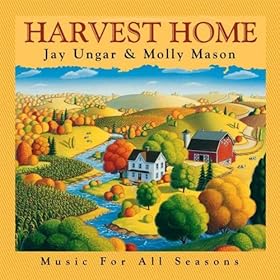
Jay Ungar & Molly Mason Harvest Home
I don't actually have this cover, I lifted it from the Amazon site. This was in a blank jewel case with nothing but the CD in it, and I suspect that's how it came since it was still firmly attached to the case. So up until I pressed play, I had no idea what was about to happen. It's from Angel, so I thought it might be a classical CD, or maybe a soundtrack.
Turns out it's a pair of traditional folk musicians. Ungar is the fiddle player and Mason is the singer/guitar player. One of the reviews over at Amazon indicates that their music is used in Ken Burns documentaries and A Prairie Home Companion. Which seems completely in place.
I don't have any context for where each song comes from. Usually groups like these pull from a variety of traditions including European and early American, sort of 'settlers music' I guess.
There's a kind of 'back porch virtuosity' that goes with this music. These are generally very technically proficient musicians able to play rather intricate figures on demand. And yet, it's supposed to sound as if your visiting uncle and aunts casually whipped out some instruments after supper and started laying down these tunes unrehearsed. Which is something that could really happen, no doubt. It's a neat trick that this brand of folk or 'traditional' music manages better than most. There manages to be an absolute respect rightfully so for the masters of this music, for their professional musicianship, without really appearing as professional musicians in the way they're regarded or carry themselves. This is not to say that they create the illusion that they have 'day jobs,' but rather that notion that the concert hall or coffee shop undergoes a musical transubstantiation to become a backporch on a lazy summer.
It's kind of remarkable. I've spent a little bit of my time on this project looking at the set of pretexts that goes into each music. The blues musicians hard workin', hard travelin', the jazz musician's kung fu-esque lineage of masters, etc. I don't have the liner notes on this to compare, it's really just something that is occurring to me as I'm writing this, thinking back to the performances and presentation on shows like the aforementioned Prairie Home Companion. It's a neat trick, because no one diminishes the musicianship, they celebrate it while at the same time presenting it as accessible. This is clearly the opposite of jazz which creates a clear delineation between those who can play and those who are just to listen.
Holy crap, it's that beef song! Or something, that song that's always used to portray upbeat down home wholesomeness! Bonaparte's Retreat/Hoedown. Man, that has been killing me for years. This is why I would get these CDs, this is why I'd collect things like this, because then not only would I finally know where the songs that inadvertently make up the soundtracks of our lives but I'd have them if I needed them. Granted, that just doesn't come up, but if it does, man am I ready.
There are two whole pieces here for Thanksgiving, which is two more than I knew there were. The first one is just a regular instrumental Thanksgiving Waltz, the second is a Hymn from the five part Harvest Home Suite that has an overture and four seasonal movements that starts with autumn. This is done with a small chamber orchestra, apparently. So the Angel label wasn't misleading after all.
Lyle Mays Solo-Improvisations for Extended Piano
There's a bit of danger in the idea of 'solo piano improvisations.' Less prominent a stereotype than the shirtless guitar noodler, the pretentious piano noodler is just as cheesy a college commons room caricature. You've seen them, broodingly tinkling out their seduction towards 'deep freshmen girls,' their bodies slumped into a question mark so their mopish bed head can obscure their face as they milk the sustain pedal and arpeggios, perhaps rocking back and forth.
The sustain pedal on the piano is, like caps lock in the persistent (is there any other kind?) meme, cruise control for cool.
I started writing this before I hit play thinking I'd have to backtrack, but I'm on the second track (I had to check) and there is a whole lot of sustain pedal going on here. Off to the liner notes to see what I'm supposed to be getting here.
Well, it's pretty much as advertised, and I kind of respect the experiment. So, the story goes in the largely sparse liner notes, Mays finished a tour with Pat Metheny then sat down and literally improvised the entire album. But then, apparently using an enhanced piano that is essentially a regular piano with a bunch of other stuff rigged to it to do things like amplify it and, it turns out, record the notes he was playing so they could 'orchestrate' some electronic accompaniment. This, it seems, is what is meant by 'expanded piano.'
I have to admit to a bit of dissapointment. I was hoping for some John Cage-esque prepared piano type of construction that would turn the piano into a compact percussion line. Instead it's somewhere between George Winston and that douchbag in the dorm lobby. Which is a little unfair, there's nothing objectively bad about what's happening...if anything in music can really be objective. It's more a bias against all those people taking up practice rooms at college that I never saw in classes pounding away at the pianos while holding down that sustain pedal like it was a land mine that would explode if it was let up.
Well, it's happened, the last of the CDs in the bag are multiples. Or are they? There are only three CDs in the bag, and two of them are large jewel cases and the other is not a CD that was for sale at my store. Of large CDs one is an opera. I just don't have it in me to do another five hour stint today, so that's for another time. But the other one is just a case of over packaging, it's in a double CD case in order to have thicker liner notes, or as they bill it 'a book.'
So lengthwise today is not as bad as I thought it was (considering I just kicked the three hour opera down the street some more.) Instead it's another one of those harsh juxtapositions.
Stephen Foster A Family Album
When folk music gets old enough, someone formalizes it. Then you get something like Camptown Races sung by an operatic tenor. This probably isn't a rule, but that's my impression of this CD right off the bat. That and it's weird to hear an operatic tenor sing about the relative happiness of the 'darkies.' Fuck, this country was racist. Anyway...
This, as I mentioned, was in a double jewel case but only had a single CD in it. It's another one of those CDs that allowed me to be pretentious without putting much effort into it. Oh, hey, Foster is the Jeannie With the Light Brown Hair guy...good to know.
Well, this is what it was for, that kind of thing. So I could not only go, "Oh, yeah, that's a Stephen Foster song," but I could also go, "And I have a recording of it right here." Sure, it'd be the stiffest recording of the song possible, but I would have it. The packaging makes a lot of the decleration of Stephen Foster Day (January 13th). I don't know if the CD came out in 2001 or not, to commerate it. Seems reasonable. Hmm, also good to know, he did that "Swannie River" song and it's not called Swannie River, it's called Old Folks at Home. I have a feeling this is just going to keep happening. Yep, there's Beautiful Dreamer.
So the book is actually a biography written by Stephen's brother and originally published in 1896. It's a little over fifty CD sized pages. I guess I should read it, but I'm a slow reader and won't be done before the album is...and, you know, I'm lazy. Apparently the CD is meant to not only demonstrate that Foster is the person who wrote all those songs, but is also a 'bonafide' Romantic era composer. Apparently, at least according to the forward, Foster was filling a need that was created by the prominence of pianos in American homes in the late 19th century.
Honestly, I really should know more about this guy than I really do. When I picked the CD up I went, "Oh, it's that 19th century folk guy that wrote a bunch of the songs we know." Which is true, but doesn't really qualify as 'knowing' anything about the guy. Or which songs, exactly.
There's a kind of depressing song about a sister asking if her brother was killed in battle, and apparently pressing for details.
And of course they bookend the collection with O' Susanna.
I don't know where someone would go to get this particular album, so I linked to their Facebook page. This would be one of the true, absolute treasures of working at a record store, the coveted consignment CD. But it's not, though it's similar in every way except one. It wasn't consigned at our store. Instead, it's a rap album from a group that included my brother.
To the best of my knowledge, my brother never listened to an abundance of rap. He has always, as long as I've known (there was a long period where we did our own things) a metal head. But he's also been pretty open and the kind of person his friends wanted to collaborate with, and so this rap album is the result.
I, however, did listen to a lot of rap a really long time ago. Like, Kurtis Blow, Egyptian Lover, Grandmaster Flash, Whodini long ago. I don't really have an impartial way to judge this music. I kind of got over the notion of my metalhead brother as rap artist when I saw this group preform in San Francisco. I thought it would be awkward but really, he kind of owned it. Like I said, I can't be impartial and say, "this is great!" or whatever. It's not embarrassing to listen to.
At the record store I kind of got used to referring to people by nicknames. Plinko, Hawkman, Roach, Railroad, The Casual Male. Almost everyone there called me Walrus. At a certain point it went from seeming weird to seeming normal. Most of the nicknames were dispersed among the skater kids that worked at and hung around the store. Flattering nicknames were not common, even Casual Male was snide. But since I left I've normalized, so it stands out now when I talk to my brother who doesn't generally use nicknames refer to members of Hurchu by their nicknames.
Being an older brother I always feel like I have to give advice, but when he was doing this I had a limited pool to draw from. "Well, I like Wu Tang, um...listen to Rza?" I have no idea if that influence is really noticeable. My understanding of the arrangement was that my brother did the beats as well as contributing rap parts. He's pretty good at manipulating his voice, so I'm not entirely sure which one is him to be honest. I'm liking the samples from Willy Wonka and the Chocolate Factory.
Ah, Explode. After my first year at UC Santa Cruz I spent the summer at my brother's place. One afternoon one of his friends came over and spent a few hours recording the hook to this song which is pretty straight forward, "Because I explode, watch me explode, because I explode." Nothing really wrong with that, it's a hook. But after a while of it I remember getting strange about it, I think doing impressions of various comedians explaining their tendency to explode and their desire to have one watch them do so.
I was able to recognize my brother on the slightly Eminem-esque rap ballad with a bit of narrative to it.
As much as the Albatross reflects my whims, it fairly decently reflects my interests as well. The perils of the Albatross and my ability to enjoy all of that on demand are well documented at this point.
I have to admit that while I have more or less complained about that in virtually every preamble (I'll eventually reach a point where I can convince myself that I don't need a preamble), there's a big part of me that I think in a way prefers it. I mean, I still listen to it on shuffle in iTunes. My favorite way to navigate the internet is through the StumbleUpon button. I have unwatched TV shows sitting on my TiVO and on the hard drive while shows I'm far less interested in scroll by in front of me.
I like to be entertained passively, and I might be the last of that breed, as even people in my generation, who didn't grow up with internet but instead grew up to invent it as we know it today, have taken to on-demand entertainment. And I don't blame them. It's awesome. But for some reason I like having the programing just happen.
That's not to say that I'm totally alone. The aforementioned Stumble does that for you, as does the rightfully popular Pandora. Technology has just enabled it to be rather fine tuned.
But for discovery to happen, sometimes you have to open things up for complete accidents.
This would be a better preamble for stuff I didn't think I would like, but today is as right up my alley as it can be without any jazz in it.
Various Artists
'Till We Outnumber 'em
After A Mighty Wind, it's hard not to approach a gathering of folk singers without a little chuckle. And this is a pretty mighty collection of folk singers, gathered to pay tribute to Woody Guthrie.
The various performers perform their versions of various Guthrie songs, and some people share stories about Guthrie or how Guthrie affected their lives. The nice part about folk music is that the music isn't really sacred, so covers open themselves to stylistic interpretation. As mindbogglingly interesting as the Pete Seeger album was, musically it was pretty flat and similar track to track. That's just the kind of music it is.
But here the takes are wide ranging, as rockers like Springsteen take on songs, or 'modern' folk artists like Ani DeFranco and Indigo Girls take on songs in their own ways.
Interspersed are some readings, almost Beat-like, including Tim Robbins reading Born Naked through a megaphone.
This album was released when that whole new folk thing was pretty big, about the right time to do that. About the only one missing from it is Tracy Chapman.
And of course the concert ends with an all-star rendition of This Land is Your Land lead by Arlo, who apparently is also telling a story over the top of it. Arlo, of course, is an awesome story teller. Turns out it's the story that forms the title of the concert.
The brevity of the post (relative to most others) might lead you to believe that it wasn't that much to write about, but it was fascinating, I ended up just listening to it instead of typing. This was pretty good.
To me, first, he was the man who would sell no wine before it was time. Then he was the man who provided "the standard rich and famous contract" for Kermit and his Muppet friends.
Finally, he was the voice of the living planet in the original Transformers movie.
Eventually he was the guy who fooled everyone with his famous Halloween broadcast of War of the Worlds, though much more was made of that than it was.
I hadn't realized it at the time, but before all of that, he was The Shadow to me.
When we would drive home late at night we would have to drive through a tree-covered grove on a two lane road. Late at night, my dad would tune to a radio station that would play old time radio programs, including what would become my favorite, The Shadow. Welles was the original voice of The Shadow as we know him (there was a Shadow that was a host to an anthology program, but The Shadow that solved crimes himself, that was Welles first.)
This formed the basis for an early love of radio theater. A large portion of my on-purpose collection consists of collections of radio theater, including this Orson Welles collections, of which Volume 3 has come up, Dracula. I don't know where the rest of the CDs are, I think one of the six is already on the hard drive (the Shadow episodes, not surprisingly). I also don't remember if I got this as a promo or if I bought it. It's a screaming bargain for what you get, which includes a Welles interviewing Wells recording (Orson and H.G.).
I don't know that I can come up with something to say about Welles that hasn't been covered by, well, anybody. As I studied film, he obviously became an important figure again.
Welles does a fairly faithful abridged adaptation, complete with the wanton blood transfusions by anyone with a vein to save Lucy from the vampire's efforts. Of course it also has a centuries old man who sucks blood to live and can turn into a bat and a wolf, so...
I have to admit that, like many people, I'm about vampired out. But there's no glittering here.
Dracula adaptations tend to leave out or marginalize my favorite character from the novel, Renfield. He is not present in this adaptation either.
Orson Welles has a knack for drama, and of course it's on display here. A lot of my favorite elements are missing, but that happens.
Agnes Moorehead was Mina Harker. For me, Moorehead will always be Samantha's mother and Darrin's meddling mother in law. And Margo Lane.
My pretension was that my music library would constitute some sort of music appreciation class. I have to admit that I envisioned it as some sort of musical equivalent of some well-read professor's den full of 'must reads.' That I would be able to walk to a section, I guess tobacco pipe in hand, and pull from some shelf and be able to remark on that moment in musical history or the importance of this particular influence or how interesting so-and-so incorporated such-and-such.
In short, I was privately plotting to be a complete bore at best and douche at worst.
I don't know why I wanted to do this. I can see people's eyes glaze over when I try to explain to them how music works or why they like the stuff they like or the development of this or that. Hell, I sometimes get bored myself. I don't throw parties and if I did I couldn't just put this stuff on random and expect anyone to stay (or at least commandeer my stereo).
Perhaps I'm living that fantasy by blogging the collection. I get to say all the 'smart and well considered' stuff about the CDs to almost no one (thanks to those that are reading), get it off my chest.
It's personified most popularly now in the Hipster's Dilemma. Alright, as far as I know no one calls it that and there probably is something else called that, but I don't feel like googling. For the sake of my argument, here is the Hipster's Dilemma: You've stumbled onto something fucking cool. It has changed the way you look at and consider whatever it comes from. Well, it's no fun to enjoy it completely by yourself, but the people already into it are way ahead of you. So you have to hip other people to it. But if that happens too often, now there are too many people into it and you're just one of the crowd.
I'm not really all that concerned that I'm going to hip 'too many' people to abrasive jazz or obscure CDs that didn't sell when they had the chance. But the first half is true. It's no fun to dig something all by your lonesome. You need that acknowledgment, this is awesome. Recognize its awesomeness.
Which travels a little bit from my original point, which is that very infrequently does the Albatross present itself in a manner that allows for that 'music appreciation' way. Except today, where it has served up another Telarc Blues release from a half session/half lead act, and a folk legend.
Essentially being represented are the two co-existing folk forms of the American 20th century played back to back. This is awesome...dammit.
Terry Evans
Walk That Walk
As much as I made of the universality of the blues in the last post, the truth is you really don't know what you're getting when you get a blues CD in the same way you wouldn't if it simply said 'jazz' or 'rock.' There's Chicago Blues, Delta Blues, there's blues that sounds suspiciously like rock (or rock that sounds a lot like blues), there are singers happy about getting the blues, there are singers seriously bummed out by the blues. There is blues that you dance to, there is blues that you tap your feet to, there is blues that you cry in your beer to.
Sometimes the cover can help you out. For instance, a lone bad-ass lookin' guy standing in something representing travel like a set of train tracks or an empty road, you're likely to get a band. It will be a little less rigid on the whole '12 bar' thing...it'll be the electric, and the singer is likely not to be happy about the blues.
According to what I was able to salvage from the liner notes, Terry Evans plays on a lot of other blues players albums and then has a handful of his own. Despite the guitar case on the cover, he only contributes guitar on a few songs, the rest of the guitar work handled by Ry Cooder, apparently returning the favor for Evans' appearing on Cooder's albums.
The truth is that I wasn't exposed to much actual blues early on. I found blues in jazz history classes where we discussed the influences and foundations of jazz. As much as I loved all the jazz I discovered in those classes I kept thinking, "No, wait, that was awesome, too...why are we spending so little time on it?"
So I used my promo-gathering as a chance to fill the gap. But since I didn't know as much about blues as I did about jazz, I grabbed everything and hoped to sort it out later. Welcome to later.
The problem is that the barrier is sometimes a little lower with blues, and as recording got cheaper a lot of people who managed to learn the 12-bar format recorded. So my blues CDs are a bit of a minefield, which made me a little gun shy to go through them.
I've already mentioned I love the lyrics in blues. So much has been said about them I'm not going to find something new and clever to say in general, but some of the stuff here is awesome. The title track really breaks down apparently to advice on what kind of shoes to buy and what to do if they're not optimal. Ultimately, don't get shoes that are too tight. Apparently. Good advice.
Dance With Your Belly Up is described at the end of the song as holding your baby tight and letting her know it'll be alright...then sort of dancing with your belly up. He says he was sure that the listener didn't know how to dance with your belly up, and he was right. Still not entirely sure. When in doubt, assume they're talking about sex.
A blues about credit cards that kind of feels like a School House Rocks element closes the CD. It almost seems like the theme song to credit reform. I wish I had been packaging a news piece and knew I had this. Pretty cool. Even has a lyric about pre-approved cards and everything. "Get you to sign that big contract / that's when they kick you in the sack." Awesome. "Credit Card Blues, gonna be in debt until they lay your body down." I guess it's kind of a middle class complaint by blues standards, but still cool.
Pete Seeger
Headlines and Footnotes
Another unwrapped CD, but this time I think it's because I intended to give this one to my friend and collaborator (you can see some of his work under 'sous rature' on The Sandwich Machine). He had gotten into Woody Guthrie and 20th Century American folk music and this was a pretty good collection. I may have gotten a few of these, so I don't know if he ever got one. I guess if he hasn't I can give him this one.
That's not to say that I don't have a fascination with this kind of music either, but he knew (and still does, I think) a lot more about it than I did. From a musical stand point it pretty much just 'is.' Often they just took traditional melodies and wrote new words over them. It is more important from a cultural anthropology stand point than a musical standpoint. That interests me a great deal, but I was behind the curve on it.
In an awesome moment of symmetry the album opens up with a song about shoes. I dig it.
There's a song about a senator named Bilbo (not a song about Lord of the Rings...) scolding him for his xenophobic policies. "Listen Mr. Bilbo, listen to me / I'll give you a lesson in history / listen while I tell you that the foreigners you hate / are the very same ones that made America great." Could sing that song now, except of course the song's subject would confuse people I guess. "Bilbo Baggins is a racist? Ah man..."
There's sort of a working class journeyman ideal image I had of him but, I'm reading in the liner notes, he had intended to be a journalist and was traveling with his musicologist father collecting songs and he caught the bug. He dropped out of Harvard and started playing. The academic turned folk singer is probably more common, I guess, and it makes sense when you consider the commentary in his songs, accented here since it's a collection of topical songs, but it does kind of deflate that romantic image. Of course the movie Face in the Crowd does a pretty good job of that, too.
I have a few of these Smithsonian Folkways collections and I liked them a great deal. They essentially cataloged the first century of American recorded music that otherwise would have been lost.
Listening to this CD is like getting short three minute history lessons in stuff where by the time you go "Wait, what happened? That's fucking crazy, when was that?" there's already another song about another crazy thing that happened that you suddenly want to know more about. This isn't folk music about friendly dragons or spinning in fields. Oh hell, as I'm typing this, a song from the point of view of a seven year old who was evaporated by the bombing of Hiroshima. Yeah, this can get pretty depressing.
From what I can gather from the liner notes, Seeger never stopped gathering music after the trip with his father. Taking poems and other written works and bringing them to a wide audience and helping convey their issues with a musicologist-meets-journalist's ear.
Little Boxes, the song not about weed that is associated with weed now because it's the theme to Weeds, is on this collection. I had been told this before but I didn't believe it, apparently the woman who wrote it (Malvina Reynolds) really did write it about Daly City, CA, which in fact looks like a bunch of little boxes from the freeway.
I have to be honest, I'm not used to paying this much attention to the lyrics, but I'm afraid of missing something important. It's completely opposite of how I usually experience music, where I start to tune in if the music hooks me and then I find out about the lyrics.
He actually explains Guantanamera, turns out that's kind of depressing, too. "With the poor people of this earth I want to share my fate / The streams of the mountain pleases me more than the sea." Apparently the last poem of a Cuban revolutionary before he was killed in an aborted uprising.
I also tend to think of his time as being older, but there's a song about the Women's Movement in 1971 (cleverly playing off "There Was an Old Woman Who Swallowed a Fly"), an anti-Vietnam song that can be applied to any quagmire situation, and a song anticipating the images from the first space flights.
Also, didn't know that The Lion Sleeps Tonight was on top of another song altogether. The whole Wimoweh thing is a South African song more or less about a king coming back to liberate his people. The Safaris (that 's what the liner notes say, Google disagrees...the Surfaris were a surf band, this song was first popularized as The Lion Sleeps Tonight by The Tokens according to the internet) just sort of co-opted and, as the liner notes put it, 'trivialized the song' into the one that we know.
An unexpected way to end a collection of folk songs: a breakdown of the science of the solar system and how it will come to an end, then an ode to his grandmother's culinary improvisational technique.
This is the kind of music you have to listen to with your finger on the Google search bar and a quick draw. The musicologist father has a lot to be proud of in his folk singing son.