Sliding through the crate it's two CDs that I thought would be a good idea to have but wasn't anxious to listen to immediately, or ever since they were never opened. Also, today we get to the 100th Amazon player widget. For those with adblock, it's a little player box above each post that allows you to listen to samples of the disc I'm listening to if it happens to be available for download at Amazon. So far, 100 of them have been.
Glenn Gould
Glenn Gould at the Movies
I was trying to think about what I'd say about Glenn Gould because classical CDs have proven to be a little on the difficult side for me to create content about and I realize something, I'm more interested in Glenn Gould as a character, or element, than I am as a performer.
There's that Cuban cigar element to his playing. That kind of thing where you think, "How much better can it really be?" until you actually hear it. Well, alright, that's pretty amazing in a world of just amazing piano players...big deal, right?
Except for what that means. I tend to think of Charlie Parker in the same way and have even used him in the Albatross that way. That monumental performer that sort of owns an instrument or a style in a way that sort of becomes unrepeatable. There have been great saxophonists since Bird, there have been great guitarists since Hendrix, and there have been great piano players since Gould. But they don't get 'the' spot. A transformational piano performer now will be the 'greatest since Gould...'
There is a novel I keep wanting to read (but c'mon, it's seriously a 200 page paragraph...) about the two piano players that show up to study with Horowitz at the same time as Gould and what that does to them. That's the kind of thing that fascinates me about Gould. Not so much the legendary status or what it was like to 'be Gould,' that kind of thing doesn't interest me. What interests me is what it's like to live in the immediate world someone like that creates, how does that change you're view of self if you're an amazing piano player in the same time and place as the amazing piano player?
This is stuff he either selected or recorded especially for films, or was used in films after his death. The first half is a bunch of harpsichord pieces played on a piano, which always feels wrong to me, but there's nothing really behind that.
On the last track he goes with 'original instrument' by playing the Art of the Fugue on an organ.
Jan Garbarek
Visible Worlds
So there was this CD I got as a promo, it was one of those rare 'classical sensations,' not as big as Chant, but did well. And this time, it was something I actually liked quite a bit. The vocal group the Hillard Ensemble recorded some motets and Norwegian saxophonist Jan Gabarek improvised over them. It actually sounded pretty cool, I loved it. I played the hell out of it at the store and even managed to lose it a few times as a personal copy and had to replace it more than once. In fact, I'm pretty sure I no longer have it, but here's hoping because on Amazon it ranges from fifty to seventy bucks, apparently.
I even attended a concert performance of that in the Grace Cathedral on Nob Hill seated right behind some important Norwegian, I don't remember now if it was a politician or a member of the royal family. All I can really remember is thinking it would be really funny to lean forward and ask if he knew of my mom's family. It was a good night for impulse control.
The success of that CD meant that there were suddenly going to be a lot more Jan Garbarek CDs. Awesome, I thought. Sucker. For the most part, Garbarek produces some pretty mild smooth jazz, though still manages to have long open solos instead of repetitive riffing, but that's what he plays. Which I guess goes to why they selected him of all people to perform with the Hillard Ensemble, but I was hoping for more experimental stuff. I mean, he is a European jazz artist, most of the European jazz artists I had run into were mostly pretty caustic free jazz artists.
Not Jan, he's mellow. And I have multiple CDs by this guy. As far as I know they're all like this.
There is no liner notes to explain the theme of this album, just this rather intense photo of Mr. Garbarek. He kind of looks like he's about to perform a feat of mentalism with his sax rather than play it.
I sound like I'm hating on him for not living up to my completely made up expectations of him and my own bias' against smooth jazz. And I guess I am, if I was fairer I'd not that he really isn't that 'smooth' with his smooth jazz, this stuff is just out there enough to avoid being played on the Quiet Storm.
I wasn't prepared for the last song to have lyrics. Of course, I have no idea what she's saying.
Being able to measure traffic is a mixed bag. Like, it's cool to see new readers who come from traffic sources I didn't know about. But then you also get to see the days when even Googlebot isn't interested in your crap.
Anyway, it's Day 69. Insert your favorite joke here.
I actually remember this CD. I got it as part of that whole 'lounge' thing that happened and of all the CDs I ever got it elicited the biggest 'what the hell...?' reactions I've had from a promo.
How to describe what is happening to my ears right now...? It's regular old 50s/60s pop-style lounge, the album starts off Girl from Ipanema. Okay, and apparently makes its way to Yellow Submarine...but then there's Mrs. Miller herself.
Imagine some sort of June Cleaver caracature of domestic mid-century motherhood/housewife-ness. Now, pretend some hack comic was going to mock her singing popular yet innoffensive tunes. Falsetto, a warbling vibrato, just sort of hammering away through the song completely oblivious.
That's what's happening. Apparently, and this comes once again from Wiki, she was a novelty act in the 60's. I'll let you read that there instead of digesting it. Being the internet, there is of course also a website. Also worth exploring. Seriously, turn off your ad-block and click the player or right click on the link in the header for the album, listen to the samples at Amazon, experience this.
Generations might have a tendency to think that they invite irony. I know that I look at the younger generations romance with irony and think, "amateurs, Gen X already nailed that down..." But apparently the Boomers were into appreciating things ironically on their own (ours was still better...). Oh good lord, A Hard Days Night...
This is the kind of thing that existed before Karaoke where you can listen to average people murder popular songs in bars across the country.
From what I'm gathering from the various websites she was that perfect combination of novelty and completely sincere. There apparently wasn't much interest in letting her in on the jokes (there was a second tier to it when she apparently was used as an icon of the drug culture late in her career to her own dismay) but for the most part she was good natured about it. Sort of a 1960s William Hung.
This is the kind of thing I loved about getting promos. There's no way I would have known anything about this unless I had gotten this CD. And now I have 50 minutes of delightful ridiculousness on my iTunes.
How has she not ended up on a Quentin Tarantino soundtrack yet?
Okay, that's ridiculously adorable. She apparently does a take on Roger Miller's King of the Road but instead it's Queen of the House. I really feel the overwhelming urge to create some referential pop-culture laden ironic movie that involves homemaking at least tangentially film just to use that song.
And of course he 'big hit,' Downtown. This kind of grows on you in an incredibly weird and indescribable way. And then there's that bizarre bird whistle...
I started this album with a 'Seriously?' and have ended it wanting to have met this woman. I feel bad because we're not entirely laughing with her but at the same time...I don't know. Very interesting.
Paul Bley Not Two, Not One
I'm cheating with the image, this is another homeless CD but I forgot to scan it before I put it in the computer and now I'm too lazy to stop the CD to scan it and for some reason don't want to do the graphic bit after the fact. Plus, the dim, gray cover lets you in on the kind of album it's going to be. Where Mrs. Miller might have been light and whimsical, this is the kind of arrhythmic, sparse and dissonant kind of music that you apparently hire Paul Motain to play drums on.
This is of course a sharp contrast to the previous album, but they were in the same CD case (to which neither of them belonged.) Which probably means they were part of one of my 'listening blitzes' that I've talked about before, where I listened to half of a few tracks on each CD and then ejecting it and moving on.
I think that every twentieth century composition class has someone at the final hammering or plucking or otherwise attacking the strings of the piano without the keys, which makes me not as receptive when modern performers do it.
This is pretty sparse, a lot of solo piano in it. But where I usually comment on the college common room piano pounders, Bley isn't any where near as dense and isn't mistaking pounding as intensity.
I like this kind of stuff, but I am having a hard time finding anything to say about it. There have been so many of these with this basic line up slipping in that I almost am just listening to it like music and forgetting this is supposed to document the experience. Or something. If this part is boring, please re-read the Mrs. Miller stuff, that's down right hypnotizing.
I don't have the liner notes to tell me what the idea behind the overall album was, but as we've learned, that doesn't always help.
I'm getting a late start today. I don't really have a reason for that, we had all of three trick or treaters last night, no parties. Just, late start. That's it. Anyway, on with the show...
Keith Jarrett
The Survivors Suite
Well, Keith Jarrett is back in the Albatross and if you read the previous Keith Jarrett post it's not a surprise that this CD was unopened. Like the other day's Tim Berne CD, this is only two long tracks, though neither reaching even thirty minutes much less Berne's fifty-plus minute single track.
This one isn't a solo piano piece the same way the other one was, in fact it took almost nine minutes for Jarrett to even get on the piano after dabbling with the bass recorder, celeste, soprano saxophone, and osi drums. Here he is joined by Dewey Redman on sax and percussion, Charlie Haden on bass, and Paul Motian on drums.
While I have to admit this is prototype pretentious music--not much air, really between the first eight minutes of the first track and the World Flutes 1 CD from early in the project, I actually am growing to really kind of dig this once they got underway. Truthfully, though, I tend to like pretentious music if a little self consciously. Obviously, with almost thirty minute long tracks, they come and go in waves.
The liner notes contain a single sentence:
"And those that create out of the holocaust of their own inheritance anything more than a convenient self-made tomb shall be known as 'Survivors'."
It's in quotations, but it doesn't attribute who the quote belongs to, so presumably Jarrett? To Google! Yep. And people quote it a lot when they write essays about abuse, apparently. I'm not even sure I understand it, to be honest. Like, if you don't take the horrible things from your situation and end up in a ball in the corner you're a survivor? I think people make it out to be an inspiration but it seems to set a lower bar. I'm probably missing something but I don't feel like reading any of the essays that use this quote right now.
Not that the track names shed any light on anything. They are "Beginning" and "Conclusion." No doubt this would have been one uninterupted suite had it been recorded in the time of CDs (or digital music) instead of LPs where he had to split it up into two sides.
There's a release that missed the boat at some point. I seem to remember (and I may have this wrong, I don't have the CD readily at hand for reasons I've exhaustively gone into) Eric Dolphy's Free Jazz fading out on the first track and fading in on the second to accommodate the two sides of the album. Where's the remaster where someone has stitched those two tracks together so we can hear them as one uninterrupted performance? If course this recording there is a clear distinction between the two tracks in tone, tempo, and approach.
I didn't hear it on the last album so I forgot about Jarrett's tendency to sing along with his solos. Put here it is, I can hear it just fine.
We've reached the free jazz section of our program. People who have been politely sitting quietly while this CD played may now get up and question the sanity of the person who put the disc on and insist it be changed, or worse, control of the music completely surrendered. I hate when that happens because to me this is when the music starts to get good. But it's definitely for a select crowd. I always want to go, "Look, I sit through crappy music I hate every day, can't you just stomach this one moment where there is some music that might be a little beyond you at the moment?" Nope, go listen to your weirdo music alone, freak.
Of course I'm getting this self-righteous to a Keith Jarrett recording, who last time I just whined about for an hour.
Fred Hersch
Songs Without Words
Another sampler of a larger box set, which I don't know that we actually carried or not. And another artist that I don't really know that much about. So far it's just solo piano, but there's no telling where it's going to go from there. I've been burned before guessing that a CD would go one way and have it take off in an entirely different direction. Especially one that is an anthology of a larger collection. I can't tell from the only note (that you can see right there) if it's a set of new recordings or if it is a collection of earlier recordings. But certainly each disc has its own set of themes.
So there's this story, or not so much story, but thing that happened, it was big on Stumble for a little bit, about a violinist going to a subway in New York and performing. Not many people stopped or paid attention to him. What he played was one of the most difficult violin pieces available, and the person who played it was Joshua Bell who had just played at a reputable hall for $150 a seat (or some such price). That story in part helped motivate a mostly stillborn project I hope to bring out soon (but no one is reading this, so I have to figure out this a little better so that people actually see it), but it also creates a weird little loop for me here.
I've gone on (and on) about piano pounders, the common room performers pumping their sustain pedal like they were inflating the piano. But then there is Hersch, who is playing standards and some of his own stuff, but it is more or less 'straight jazz.' The kind of 'straight jazz' that a piano player might play in a bar or casino lobby where a slightly drunk record store clerk/buyer might be egged on by head buyer turned label rep to stumble up and request Girl From Ipanema. Good times.
So it's easy to listen to solo piano performing 'straight jazz' and thing hotel lobby, or casino bar, or Nordstroms floor. But I've known a piano player who played on the Nordstroms floor and he was remarkable. It's conceivable that Hersch spent his time playing in hotel lobbies and casino bars.
Thing is, I do this a lot. I keep associating the music I'm listening to in terms of where I would be likely to hear it. And if I'm honest, it's at least partially derogatory. But, clearly, that's not entirely fair. It could easily be an undiscovered Hersch. A Joshua Bell conducting a social experiment. In fact Bell's experiment was about this, that the quality under which we rate music is largely, and embarrassingly, contextual. This is good piano because it's on a CD. Bar piano is not as good because it's just a guy at a bar. Perhaps, if I get sauced enough I'll put bread in their jar and ask what they're doing there, but I don't know that I'll mean it.
So sure, this is good. It's on a CD. He was allowed to record a three CD set no less. Nonsuch records endorses him and I'm given the CD and I listen to it and presumably I agree because it was on a CD and Nonsuch is release three at a time and it will be good. It is better than what you might hear at the bar or the casino or the hotel or Nordstroms because this is on a CD and Nonsuch and my record store said it was good. And it is good. I don't mean to imply that it isn't.
But I think that the notion of context, of having to do two of these every day and realizing what kind of short hand that I begin to use to digest the music, to put it in its place so I can find something to say about it.
Drums and a bass show up for Easy to Love before we get one of three variations of the title track. This one is labeled Aria. We have waltz and ballads to look forward to.
We also get some horns mixed in before we go to the mellow 'ballad' version of the title track to wrap up the collection. A rather standard way to put together a compilation, a little bit of solo, some piano trio, a combo, and the defining track in few forms.
I hate the bottom of a bag. I don't even know why. Sure, some of the self selecting that insures that some of the bottom of the bag is not going to be all that great. But ultimately, this stuff is randomly assembled, no one bag is any different than the other, but so far I get pretty anxious to move on to the next bag, like I'm convinced that next one has all the treasures I've been looking for, and I could get right to it, if it wasn't for these blah CDs I have to do first. I wonder if it actually makes me meaner to the bottom of the bag CDs.
Jack Jezzro Jazz Elegance: The Trio Recordings
Not the greatest sign when iTunes thinks that this is an easy listening CD, despite the complete insistence of the title that it is in fact jazz elegance...
But yeah, it's winery jazz. A little guitar trio playing some mellow standards and some original bits. Good enough to listen to, not aggressive enough to disturb your wine tasting experience.
I was fairly sure that this is what I was going to end up playing. I'm always down on it in these posts because it isn't as dynamic or weird or whatever as the other CDs, but I don't really have a problem with it ultimately.
The liner notes flip the order of things a little bit, almost like the person sensed that he'd have to address up front that this was going to be a light weight set of recordings. He goes into all the 'flash' criteria people use to determine the value of an artist and implies that another measure, 'taste,' should be applied. Then the usual tour through the selections, timeless melodies etc. But usually the resume comes before all of this, but instead it follows. Ah, and it's because it includes him having released a few 'easy listening' CDs before this album, as well as apparently television soundtrack work. The salesmanship had to flip there a little bit to sell him as a jazz artist in spite of some of his background instead of because of it. His resume as a studio musician and bass player in an orchestra aren't the usual jazz bonafides that you can build on, so on the second page of the notes they go.
I've played about half the songs on this album.
I had this elaborate plan on prom to play Prelude to a Kiss at some point in the evening on my sax and then we'd have a crazy romantic kiss immediately afterward. It was a long walk for a kiss, and of course not necessary. We just started making out when she switched to comfortable shoes. That was right before we found out that I had parked in the front yard of a church. This is a pretty ridiculous pattern of me wanting the names of the jazz tunes to do the thing that they are, Maiden Voyage, Prelude to a Kiss...I guess I should be careful now who I play Serenade to a Cuckoo around, that's a mixed message that won't be fun to unpack...
This album brings the number of versions of Round Midnight to four. I suspect by the end of the project I should be able to create a fairly substantial play list of just Round Midnight. This version is about what you'd suspect.
Alan Pasqua My New Old Friend
From guitar trio to piano trio, it's a light jazz day today. I don't know if this is going to be light weight or not yet, it's still loading, but Wichita Lineman is on here, so my chances are pretty good. I don't see any vocal credits on here, so at least there is that.
There are no liner notes to save me this time either, just a dedication to "you, the listener." What a weird affectation. "Oh, I'm the listener...I was wondering what my role was in this thing."
Alright, we're underway. Before reading the track list and the credits I was kind of looking forward to this CD because it was a different kind of case for the CD. That can be an indicator of music that is also different, a little out there. Or that the manufacturer had a different supplier for their CD sleeves. This time it's the latter.
Since I don't have liner notes I had to go to our old friend Wiki, turns out that he is the guy who did the theme to the CBS Evening News. And apparently played with a lot of 80s rock bands.
Ah, the whispery voiced back up 'aaah la da dah' girl usually reserved for bossa nova recordings. Highway 14 must be a pretty mellow stretch of road.
Not to be outdone, this album brings the number of versions of Body & Soul up to five. I should start taking predictions on what's going to be the most represented song by, like, the 150th day or something.
It may not be possible to do an instrumental version of Wichita Lineman and not have it sound like we should be in an elevator. Smile is the same story, but it's such a pretty tune it doesn't matter.
Well, I'm all caught up on the 8tracks thing. Now I can do them as I go so it's not so time intensive. Back to our regularly scheduled program.
George Duke After Hours
I have to admit, I was rooting for this homeless CD to not make it. The back is fairly scratched and in fact a few of the tracks didn't make it over in their entirety. But now I'm a little bummed about it because it's not the worst thing.
First, I thought that George Duke was a guitar player, apparently not. Keyboards. I associated him largely with smooth jazz, but while he is playing fusion it's not as...mellow. Well, this second track is. But the first one was kind of funky.
I just cringe when I get titles like "After Hours." I tend to expect Tim Meadows to introduce it on 'The Quiet Storm.' To be fair to Duke (who has an impressive resume looking at Wiki), the only thing that separates After Dinner Drinks from a 'straight ahead' jazz piece is the synthesizer sounds and drum machine feel.
I've added to my dissapointment because I couldn't get the CD to play directly, so I listened to it from the library. But I forgot to turn shuffle off, so for a minute when the first track was followed by a blues song I found myself going, "Well, there's a direction I didn't expect." But when that lead into the theme to Space Ghost I knew I had screwed up.
This is kind of soundtrack jazz. Not necessarily porn soundtrack jazz, maybe romantic montage soundtrack or something to that effect. Or parents jazz. It's hard to get excited about but seems unnecessary to trash it. I wish I had started this CD earlier, though.
Together as One is more or less a straight up piano trio piece, a ballad of course.
Once again I'm letting my bias towards smooth jazz color how I approach the CD since it's really not that bad.
I must have listened to it, it's been out of its case for a really long time. Though I probably gave in after the first few seconds of the first track to move onto something else.
Mose Allison The Mose Allison Chronicles - Live in London
Ah, back to straight ahead land. I have no idea how 'straight ahead' became the distinctive phrase for non-fusion jazz. I don't even know how many people use that, it's just what I heard when I was a teenager and wanted to make that distinction.
I don't really know anything about Mose Allison. He's one of those that I think I should know, I just don't. There are a lot of those in my promos. I would get them and if the rep handed them to me directly I'd say something open ended and vague like, "Sweet, thanks man!" like I was a fan or something, but mostly it was "Great, now I can figure out what this artist is all about!" But then I never took this CD out of its case, so I never learned what Allison was all about.
Like, I wasn't expecting singing. Which is, apparently, what he is known for.
This is live, obviously, but the location is pretty awesome. It's at a pizza place in London where, according to the liner notes, Allison plays at quite a deal. He seems like a half way between a Bob Dorough/Randy Newman and Dr. John.
I got distracted during Middle Class White Boy and I think I missed something. But it's a long CD and I'm kind of tired. Now instead I'm getting a sorrowful rendition of You Are My Sunshine...
Much is made in the liner notes and other sources about Allison's dry wit. He may or may not be that prototype for singers with that folksy jazz songs with ironic lyrics.
Passing the milestone yesterday seems like I should be doing something new. I have a notion that is so mindblowingly self indulgent that I dare not speak its name unless I follow through on it. As it is this project has a blog, a Facebook page, a Picasa gallery...the only thing it's missing is actual readership. But I still can't shake the urge to expand even further. Shameless.
Until that time, on with the regularly scheduled self-indulgence.
That doesn't always make him easy to listen to, though. It also hasn't given me what I expected, some truly pretentious liner notes explaining the works on this album. Instead it's simple white with impressionistic painting (I may have that wrong, when it comes to art I'm pretty much nowhere) and simple typeset indicated the tracks. There are four pieces with two to three segments each, Staircase, Hourglass, Sundial, and Sand.
Reaction to this album, and Jarrett in general tends to be pretty emotional. You often hear things like 'open your heart' to the music, or their mind. Or ears. Or something.
Minimalism, which this album uses a lot of, is often a hard sell. It's hard to convince someone that very little music is in fact something to behold. Often the jazz notion of 'the notes they didn't play' is rightfully made fun of. (from the Simpsons, "Pfff, I can do that at home.") But as easy to make fun of as that is, it's kind of true. There is something to be said for stripping music down as far as you can, to see how much music implies and how that effects the listener.
Having said all of that, I have a hard time with Jarrett. I recognize the talent, I do. Jarrett is probably the absolute best at what he does. But I have a hard time getting into piano noodling (and I recognize that it's demeaning to call it piano noodling and it's more than that). If you like piano noodling, though, this is probably among the best piano noodling you'll find.
If you're in the right mood for this kind of thing, this really would be pretty amazing I'd have to grant.
It's hard to be a trumpet player named Dizzy if your last name isn't also Gillespie. This Jamican born trumpet player, according to the rather straight forward biographical liner notes, became fascinated with brass at his father's movie theater.
This has a contender for track title, The Case of the Frightened Lover, which was actually just a normal up beat bop number.
There's a pretty impressive list of musicians on here. Art Blakey, Stanley Turrentine...apparently he was (well is, he's still around) a 'musician's musician,' well liked among other musicians but didn't quite seem to get the traction with the public. From what I'm finding this Blue Note recordings was the crest of his time with Blue Note and as a band leader. He's continued to play but hasn't really gotten the penetration that other players have.
The music is pretty good. He doubles on congo, which I had already forgot about until Achmet started with a congo solo that trades off with Art Blakey. Not really something you'd hear in bop until the other Dizzy became fascinated with Latin music and started incorporated it into his bop music.
Another feel bad moment, because this is a pretty decent album but I still don't really have much to say about it. My interest peaked at Achmet, that was pretty cool.
I missed a chance to name a day, I called the 42nd day the 'Meaning of Life Day,' I should have called yesterday Richard Petty Day. I got nothing for the 44th day.
There are CDs in here from people I've never heard of who have volumes of work, meaning that they've managed to sustain interest in at least a branch of their work to merit multiple volumes. Usually it's only a 'volume two' and yet I still feel bad that I don't know who these people are--especially since it was kind of my job to know who they were and someone handed me a CD so I would.
But I don't, and I didn't. And I don't know who this guy is despite him apparently having a series of four CD's asking...I'm not sure--if his flute said something? Which flute he should use? It's unclear.
Alright, enough of that.
I was kind of expecting a few things, either another one of those 'world of flutes' type CDs, or something on the 'easy listening' end of the spectrum, or at least cool jazz. I guess it's got some elements of the latter. But that might just be my bias towards the 'mellowing agents' that I think flute and guitar have (despite thinking Roland Kirk's flutes are awesomely funky.) But this is really just straight combo jazz, a little Coltrane, standards like Lester Leaps In.
Well, completely wrong about the album title. I guess not completely wrong, it is his fourth album. But according to the rather sparse liner notes, it's in response to the 'mad-positive' response he got to his previous album 3 Flutes Up where he played three different flutes. So on this he upped the ante. Fair enough. You don't usually get to hear much else other than the 'normal' flute and the piccolo.
This is really kind of good. Apparently not famous enough for Wikipedia. His bio tends to focus on the fact that he plays more than just the normal concert C flute. Released in 2000, this appears to be the last album he put out, at least according to his website. Too bad, I'm kind of getting into this. Flashback is pretty funky.
Jacky Terrasson
A Paris
Yet another Blue Note CD. I wonder how much of the Blue Note catalog I actually have...it has to be significant...it is a large catalog, but still...
Now we get Jacky Terrasson on his own.
This actually got off to a pretty good start with a slow funky groove (I know I call a lot of things funky, it's not because I lack another term but rather I listen to a lot of stuff that is in fact funky.)
These two albums are actually fairly complementary. There's a general lightness to them, a little playfulness in their set up, with some underlying funkiness thrown in and some straight up technical progressive jazz. Both kind of easy to listen to and kind of hypnotize. I feel like both entries are kind of light (I've usually written way more at this stage in the album, I'm already half way through), but that's because I start to just sit back and listen to it.
The sad thing is that I don't know that these songs are going to stand out on the iTunes shuffle. Already, at something like 88+ cds having gone into the hard drive when I put it on shuffle there have been songs that have come up where I think, "Where did this come from?" despite having listened to each one and written about it. So out of sheer volume good music like this, music that is just good to listen to, won't necessarily stand out. Rather what is going to grab attention is the bombastic, the weird, the caustic. Those are going to be the tracks where I go, "Oh yeah, I remember that." With this stuff I might think just as the song ends "That was good, who was that again? Ah, too late...next time around." I mean, I already forgot that I already did one Jacky Terrasson album.
This might be a quality shared in the world at large, where there is no time for the good to stand out--only enough for the loud and strange to stand out and be noticed. As a result, I feel like I'm condemning a CD when I merely call it 'good.'
Ah, sweet, La Vie En Rose is the name of that tune they always play when showing Paris. Now I know.
I don't understand the 'fade in'. I don't really like fade outs, but fade ins I don't get at all.
Both albums end with a kind of poppy bit with vocals, even. Terrasson's is a little more upbeat and more likely for me to not associate it with the rest of the album when it comes up on random later.
I think I hit a vein. This bag must have represented a portion of CDs that I listened to in rotation until a move when they were lost in the shuffle. The grab for this was a series of bittersweet moments. What I thought I was grabbing was Sun Ra's Angels and Demons at Play, which is a fantastic album which I would love to have on my iTunes. It's an album I not only bought on purpose, but I special ordered (well, I was the buyer for that section, so I just ordered it, but it never made it to the floor because I ordered it for me.) Although now that I think about it, I believe I've seen that CD loose before, so I should have known.
Instead, however, it was the major label compilation for The Cherry Poppin' Daddies, Zoot Suit Riot. Which is cool in its own way. I actually love this band. I can feel you cringing from here. I'll get to why in the review. However, since it's a compilation I already have most of that album on iTunes, so I kept digging.
There was a CD case for a box set of Beat Generation recordings that I have already ported to iTunes, but learning from my earlier experience I checked. Sure enough, inside was Sex Mob's Din of Inequity. This, too, is on my iTunes. It actually makes me a little sad, because I was sure this CD was lost and I also love Sex Mob, so I re-bought the CD through the iTunes store a few years ago. It seemed easier than scouring the collection to find out where it went. Turns out it was sitting in the Beat Generation CD case...
But that CD is already in, so digging I go and we come up with my second radio program. Finally. Though now I really just want to go through the bag to find out what else is buried in there...
I've already commented about how Europe loves jazz more than Americans (being the backdrop of the movie Round Midnight). This CD is a product of that phenomenon, a collections of sessions from 1957 to 1964 with a pretty comprehensive whose who on it.
It has two saxophonists on it that I was into pretty early on in my discovery of jazz, a product of being taught by my own set of old jazz men. So early on I was hunting out recordings of Zoot Sims and Johnny Griffin. As a result this has the sound of 'the jazz I listened to before I knew what the hell I was listening to or for.'
Ideally there would be some sort of profound realization, like retroactively going back to my head and unlocking the secrets of the music that moved me to want to be a jazz musician. Unfortunately, I got nothing. I just liked it. I like it now. My tastes have grown more 'refined' in what I like specifically, so when going through the giant rolodex of what is available in jazz I might skip over a Bud Powell CD despite him being a legendary player. But it's still good, and I could close my eyes and easily transport myself back to my old Chevy playing this over my 40 watt Radio Shack car stereo (with equalizer!).
This is also the second version of Satin Doll to go in since I started using it as my go-to 'generic jazz standard.'
It's hard to come up with something to say here, I mean it's Bud Powell. I feel like I should though, with how hard on piano players in general I have been.
This doesn't have that Rudy van Gelder edition style cleanness about it, there is a definite difference in the quality of each session. Not to say that it's a messy as the Nat King Cole album, but it certainly retains a lot of its, lets call it 'analog charm.'
I've talked before about jazz piano players revisiting those classical lessons they endured in childhood and trying to 'jazz them up.' This however just contains a short track of Bud doing some straight, unidentified Bach labeled Bud on Bach.
The Cherry Poppin' Daddies Zoot Suit Riot
I don't have a cover to go with this one because it was mislaid in a Sun Ra CD case. I thought I had lost this and that is still technically true, because I actually got three of these. I think I gave one away and then lost the other and got the third to replace it. Then, apparently, it made its way into a Sun Ra CD case. I let it go because of a few reasons. First, if I lose three that might be a sign. Second, this was their 'breakout' album that made them a one hit wonder to everyone else who hadn't been collecting their CDs. Third, it was really just a compilation of the first three albums that I already had with four new tracks added in.
This was their major label signing, which happened to coincide with the sudden and inexplicable flash in the pan popularity of New Swing music. Sadly, The Daddies were picked up on that, so the label went through their albums and pulled out all the swing related songs on their previous albums and put them on this one. Even sadder, this didn't happen until new swing was on its downward arch where it had become a bigger joke than it was something people genuinely 'liked.' So The Daddies became the face of a ridiculous trend that they weren't really following.
In a lot of ways there were a more genuine extension of jump jive bands rather than a revival. They didn't go for 'authentic,' often they didn't even go for swing at all. The album before this one barely contained any swing elements at all. There's as much rock influence from bands like Oingo Boingo as there is Cab Calloway. And their subject matter was not really poodle skirts and derby hats--their one hit, after all, is about a race riot.
Since it is a compilation I already have most of the songs, I just needed the four new tracks loaded up. Having made all the excuses for them, all four of these songs are about as traditional jump jive as they ever get. I like to think that there was some angry "Told you so!" yelling when they went for their second album, because that one was the funkiest in their catalog. Not that it made any difference, they were the poster children for the Swing fad. Singer Steve Perry (different Steve Perry) went and got a degree in molecular biology, released a glam rock album under another name, and eventually came back to The Daddies.
W.C. Fields The Best of W.C. Fields
In theory I should like radio comedy more than anything. It was the first of the radio theater I had found. At some point someone had recorded a Jack Benny program either off the radio or a record or something that also contained Who's On First and an episode of Burns and Allen. I wore that tape out listening to it, pretty close to memorized the whole thing.
But it was later when I discovered mysteries and sci-fi radio dramas that I finally realized my love for old time radio.
I got this as a set of CDs that contained highlights of various radio dramas on the cheap. Apparently it's not available anymore because even the ISBN doesn't come up. I hadn't been exposed to much W.C. Fields so I wanted to at least have a sampler.
All I remember from the first time I listened to this was how odd it was to have a ventriliquest dummy as a character on a radio show. I know that the show is done in front of an audience, but it's still a radio program. It's such a strange device to use in the comedy. Today they might call it 'meta.' Or maybe not.
Most of this is essentially sparring matches between Fields and Charlie McCarthy the dummy and have the host of The Chase and Sandborn hour set him up for his rambling stories where he would flaunt the rules of the broadcast as a way to seed his movies and the show's sponsors.
I wish there was a good reason I was getting a late start today, but there really isn't. Also, I've let the CDs take over again and I'm starting to hear the tell-tale crunch as the CDs get under foot. Someone warned me about this, but if I started listening now it would just set a dangerous precedent.
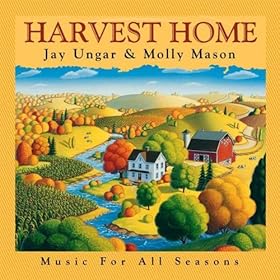
Jay Ungar & Molly Mason Harvest Home
I don't actually have this cover, I lifted it from the Amazon site. This was in a blank jewel case with nothing but the CD in it, and I suspect that's how it came since it was still firmly attached to the case. So up until I pressed play, I had no idea what was about to happen. It's from Angel, so I thought it might be a classical CD, or maybe a soundtrack.
Turns out it's a pair of traditional folk musicians. Ungar is the fiddle player and Mason is the singer/guitar player. One of the reviews over at Amazon indicates that their music is used in Ken Burns documentaries and A Prairie Home Companion. Which seems completely in place.
I don't have any context for where each song comes from. Usually groups like these pull from a variety of traditions including European and early American, sort of 'settlers music' I guess.
There's a kind of 'back porch virtuosity' that goes with this music. These are generally very technically proficient musicians able to play rather intricate figures on demand. And yet, it's supposed to sound as if your visiting uncle and aunts casually whipped out some instruments after supper and started laying down these tunes unrehearsed. Which is something that could really happen, no doubt. It's a neat trick that this brand of folk or 'traditional' music manages better than most. There manages to be an absolute respect rightfully so for the masters of this music, for their professional musicianship, without really appearing as professional musicians in the way they're regarded or carry themselves. This is not to say that they create the illusion that they have 'day jobs,' but rather that notion that the concert hall or coffee shop undergoes a musical transubstantiation to become a backporch on a lazy summer.
It's kind of remarkable. I've spent a little bit of my time on this project looking at the set of pretexts that goes into each music. The blues musicians hard workin', hard travelin', the jazz musician's kung fu-esque lineage of masters, etc. I don't have the liner notes on this to compare, it's really just something that is occurring to me as I'm writing this, thinking back to the performances and presentation on shows like the aforementioned Prairie Home Companion. It's a neat trick, because no one diminishes the musicianship, they celebrate it while at the same time presenting it as accessible. This is clearly the opposite of jazz which creates a clear delineation between those who can play and those who are just to listen.
Holy crap, it's that beef song! Or something, that song that's always used to portray upbeat down home wholesomeness! Bonaparte's Retreat/Hoedown. Man, that has been killing me for years. This is why I would get these CDs, this is why I'd collect things like this, because then not only would I finally know where the songs that inadvertently make up the soundtracks of our lives but I'd have them if I needed them. Granted, that just doesn't come up, but if it does, man am I ready.
There are two whole pieces here for Thanksgiving, which is two more than I knew there were. The first one is just a regular instrumental Thanksgiving Waltz, the second is a Hymn from the five part Harvest Home Suite that has an overture and four seasonal movements that starts with autumn. This is done with a small chamber orchestra, apparently. So the Angel label wasn't misleading after all.
Lyle Mays Solo-Improvisations for Extended Piano
There's a bit of danger in the idea of 'solo piano improvisations.' Less prominent a stereotype than the shirtless guitar noodler, the pretentious piano noodler is just as cheesy a college commons room caricature. You've seen them, broodingly tinkling out their seduction towards 'deep freshmen girls,' their bodies slumped into a question mark so their mopish bed head can obscure their face as they milk the sustain pedal and arpeggios, perhaps rocking back and forth.
The sustain pedal on the piano is, like caps lock in the persistent (is there any other kind?) meme, cruise control for cool.
I started writing this before I hit play thinking I'd have to backtrack, but I'm on the second track (I had to check) and there is a whole lot of sustain pedal going on here. Off to the liner notes to see what I'm supposed to be getting here.
Well, it's pretty much as advertised, and I kind of respect the experiment. So, the story goes in the largely sparse liner notes, Mays finished a tour with Pat Metheny then sat down and literally improvised the entire album. But then, apparently using an enhanced piano that is essentially a regular piano with a bunch of other stuff rigged to it to do things like amplify it and, it turns out, record the notes he was playing so they could 'orchestrate' some electronic accompaniment. This, it seems, is what is meant by 'expanded piano.'
I have to admit to a bit of dissapointment. I was hoping for some John Cage-esque prepared piano type of construction that would turn the piano into a compact percussion line. Instead it's somewhere between George Winston and that douchbag in the dorm lobby. Which is a little unfair, there's nothing objectively bad about what's happening...if anything in music can really be objective. It's more a bias against all those people taking up practice rooms at college that I never saw in classes pounding away at the pianos while holding down that sustain pedal like it was a land mine that would explode if it was let up.
Rudy van Gelder and another curio show up today. I really have no idea what to expect from the Herbert Herhbein. I'm intrigued to see if my new understanding that I really like Hard Bop will hold up.
Ping, by the way, finally (well, 'finally'...I've had iTunes 10 for less than a month...) does what I thought it did, so you can follow the project through there. I guess, by the way, I'm going to handle the Ping thing (ha!) by just taking any signifigent quote I make about a specific track and posting it to Ping. And of course, since everything on the net is in someway Google's, there is a Picasa page of all the album covers. I'm not really sure who any of that is for, but I am providing as many ways to not be followed as I can, I guess. The album cover collection now also plays from the Picasa on the side bar.
The other CD is a double, so really I should just get to it.
Horace Silver Song For My Father
It really is appearing as if the Blue Note rep, whoever he was, was very generous. And really, without much need. This is another one of the Rudy van Gelder re-issues. Thing is that it's Blue Note, really the jazz label. I was going to carry these CDs or it wasn't really going to be a jazz section. In fact, I don't know that I really even had a say in the matter. Most of these might have been ordered as part of the overall order from the distributor and thus handled by the store's main buyer.
But I still got a boat load of Blue Note CDs. It didn't occur to me to keep track, but a clear majority of the jazz CDs that have gone in so far have been Blue Note CDs. I mean, obviously that's going to at least in part be a product of how dominant a label Blue Note is for jazz, but also that whoever handled their distribution for the store was incredible generous with the CDs anyway.
I'm not complaining, I have a lot of those 'must have, essential' jazz recordings because of that. And I'm apparently pretty blase´about it. Most of them aren't even opened, including this one.
Which brings me to the other, non-musical and yet weird part about it.
The credit card application. The CD came with a credit card application. Fell out when I opened the CD. This actually happened a lot, little offers of some sort or another would be included in the CD. I never really took much notice of them before. Usually they were offers to join some sort of mailing list or whatnot regarding the label, but I was a buyer, I was already in the loop. So I never really paid attention to them. This was late nineties.
But post-credit crisis, this suddenly stands out to me. A credit card offer in my CD? It is a Blue Note credit card, at least. I guess...apparently you get 'jazz insider' benefits that allow you to collect points to get Blue Note stuff and to select your own compilation that will list you as 'producer.' This act, apparently, makes you a 'jazz insider.'
I actually have no idea what the terms for credit cards are these days. This one is 3.9% for the first six months and then 9.99%, unless you miss two payments, then it's 19.99%...unless they're consecutive in which case it's 22.99%.
Really attached to that .99% thing.
There's a weird note to Wisconsin residents-
No provision of any marital property agreement, unilateral statement or court decree adversely affects the rights of First USA, unless a copy of each agreement, statement or court order is furnished to First USA, prior to the time credit is granted, or First USA has actual knowledge of the adverse obligation. All obligations on this account will be incurred in the interest of my marriage or family. I understand that First USA may be required to give notice of this account to my spouse.
I don't understand any of that. Well, except that apparently First USA might have to tell your spouse that you have the card.
Oh yeah, and there's a CD in here as well. Which is pretty awesome. I'm pretty sure I played the title track in jazz camp.
That's right. I went to jazz camp. As far as I know nothing untoward happened with anyone's instruments, flute or otherwise. Mostly it's where I discovered my laziness towards the new need to shave. I came home both years fuzzy. And one year a much better sounding saxophonist thanks to an instructor who hated my guts.
Horace Silver's Lonely Woman is a little more solemn and less...wailing? than Ornette Coleman's, which is a song I futiley try and hum now and then. Not that this piano trio Lonely Woman is easy to hum. But it is, obviously, more conventional.
This album has two contenders for awesome song name. The first is this groovin' number playing right now, Sanctimonious Sam and the other is the one that closes the album out, Silver Treads Among My Soul.
This is going to be a little rough. Listening to 'easy listening' music intently during normal circumstances is a bit of a sleep aide, but to do it while you're tired is something else. I'm up early to watch the Petite Le Mans from Road Atlanta and I was up late trying unsuccessfully trying to customize the theme of the blog (short story, their advice on how big the photo has to be to complete the background is a filthy lie...)
My initial strategy to find something to say about this CD was to try and link it to the Bert Kaempfret CD, but apparently I don't have to work all that hard on it. The rather anemic liner notes tell me that aside from Rehbein's apparent 'signature' string sound, he was a long time composing partner to Bert. So it's not just that I somehow tapped a vein of German based easy listening orchestras, it's entirely possible that these albums were released together and I got the promos at the same time.
While Kaempfret's CD was surprisingly jazzy, this one is not at all. This shouldn't be a surprise after a glance at the original liner notes to all three albums. Here are the first lines of each:
"It has been aptly said that "Music has charms that soothe the savage..." It has even been stated that this phenomenon actually works." -Music To Soothe That Tiger
"The mood is romantic...the songs are haunting, nostalgic, the language of love...the artist, a musical sorcerer named Herbert Rehbein." -Love After Midnight
"The days, we spend in doing...the nights, in dreaming.
The mood may be serene, or bittersweet with memory...a love a reality, or an unfulfilled longing...a moment shared, or spent in solitude. But whatever the time or the setting, the songs dedicated to love hear in this album fully express the thoughts and emotions of lovers everywhere." -...And So To Bed
In the same way that blues liner notes have to sell the artist as a hardboiled voodoo priest of pain and heartache the easy listening notes have to, it seems, sell the artist as a romantic enchanter wielding his soothing tones to take you to a magic world of sensuality.
It is not, by any stretch, dynamic music. But I have to say, it's kind of growing on me. Not that I would listen to this music in...well, most situations. And certainly not as prescribed. I don't want to speak for the 'ladies' but this might knock them out instead of get them in the mood, so to speak. Who knows. The covers are pretty racy, from the apparently topless woman in a leotard hugging the tiger skin rug on Music To Soothe That Tiger to the nude back of the woman taking off her lingerie on ...And So To Bed, leaving not much mystery as to what is about to happen once we get there.
One CD down, one to go. So far I've only nodded off once during a full course caution in the race. (I know I nodded off because I went to sleep under yellow and woke up to them racing...of course just in time for someone else to crash...). There is no way to pair endurance sports car racing to easy listening music, it's not even surreal, it just doesn't go.
I can't listen to any version of It Was a Very Good Year without thinking about Homer Simpson. We must have hit the Frank Sinatra vein, as the very next song is Strangers In the Night.
These tracks are remarkably short, but you'd never know that listening to them.
What easy listening collection is complete without a version of Spanish Eyes. I talked before about this being the thinking behind getting a CD like this, that there was going to be this one clutch moment in theater or film or something where someone was going to go, "Man, if we only had a version of (say) Spanish Eyes..." and then, like Spiderman I would arrive just in time with my copy of Spanish Eyes. And then the lead actress would swoon. Or something like that. More likely she'd regard that along with everything else as "not her lines." I was literally dumbfounded when I first encountered an actor who counted her lines. I think I muttered something like "well, make the most of them."
As much as I chide, Bert Keampfert drives the most search traffic to this blog, at least according to my stat measures. I guess we'll see what Herb does. Though if you're doing a search for either I can't help but think this would be a disappointing result.
Well, I made it--easy listening double CD that I don't remember getting. Day 36 under the belt...
Back in the swing of things with a shiny new computer and an iTunes with a weird new look. Not that it really matters, because it's the same old Albatross. Today there is an actual apples to apples comparison, not that the selections really have to be compared by any stretch of the imagination.
But it's two piano players, the legendary Thelonious Monk and Kenny Kirkland, the late piano player for the Branford Marsalis Quartet.
Kenny Kirkland
Kenny Kirkland
I have to first be honest, I have spent most of this CD being too clever for my new computer. Apparently, after searching for drivers and trying to install them and then make everything work the way it used to, the machine came packed with everything needed already in it and all I had to do was plug stuff in and go. I hate when I'm the one who can't set the clock on the VCR, but then by making that dated a reference I fear I'm doomed to be just that.
I should clarify that, in high school and for some time after that, I was a fan of the Branford Marsalis Quartet like other kids may be fans of Green Day or Blink 182 or Good Charlotte or whatever. (I should have come up with bands from when I was in high school instead of bands that were popular when I worked at the record store, but I honestly couldn't think of any... I was too busy being a fan of the Branford Marsalis Quartet.)
I even sat in an elevator for a few hours waiting for a show to open so I could get tickets. (Perhaps, you are thinking, a true fan would have bought tickets in advance...well, I didn't have a lot of cash and only got paid that day, smartypants.) The show was taking place on the third story of a three story restaurant with a performance lounge. The third story wouldn't open up until the show started and I didn't want to hang out in the lobby. (I found out the third story didn't open up by accidentally gaining access to it and being asked, "Oh, are you with the band?" Foolishly, I said no.) I was joined by a fellow music major (I was a music major at SacState at the time) and we sat on the floor of the elevator waiting it out.
That's when a man in the same Spiderman t-shirt I was wearing walked in with another man using a cane. I made a casual comment about Spiderman and turned to my friend who was aghast. I asked what was up and he simply pointed and went, "Kenny Kirkland." It was then I realized that the person I was talking Spiderman with was Jeff "Tain" Watts. Watts turned to continue the conversation with me once he got out of the elevator but I hadn't gotten the nerve to follow him and I once again missed my free ticket to hang out with the band.
What does any of this have to do with Kenny Kirkland's self titled album? Not much, but I have met him and it was awesome.
In a lot of ways it really is a Branford Marsalis Quartet with Kirkland calling the tunes. There are a few tracks with different artists on that wouldn't happen on a Marsalis CD (since they don't involve the saxophone). So basically it's my favorite band with the piano player calling the shots for a change.
So you'd think I was definitely happy to get this promo. And I likely was. But it wasn't opened. This one actually baffles me, because, like I said, I was a huge fan. I really have no idea how this managed to escape being played even once. Perhaps it's one of those CDs that I got duplicates of and somewhere in the Albatross there is an open copy floating around. It's a good album, but I'm not an impartial judge.
The liner notes are pretty classic jazz liner notes, even if they are written by Branford himself. It starts out with the traditional throw to the history of jazz, followed by trying to place the artist within that history of jazz. If the player is modern like Kirkland, then you have to establish him or her through the artist's influences.
Then there is the run down of how that artist applies these influences. Since this is written by a fellow artist who actual plays with Kirkland, so it wanders into strict music theory that you'd have to be a musician to understand.
Sometimes I wonder if jazz fans who aren't musicians (at a certain point, I start to wonder if the only fans of jazz music are musicians themselves and this is just natural) understand all of that theory babble that accompanies discussing jazz or if it's just the 'noise' they accept as part of the conversation, like they learn what these mean in the abstract, as if Csus7 means "red" to them or something.
Thelonious Monk
Genius of Modern Music V.1
Monk looms huge. It's hard to pick a Thelonious Monk story to start with to get into my relationship to Monk's music.
Ultimately, I should talk about the first Monk promo I got, and how it led to me having to compete for promos ever since.
I was hanging out with my friend who was the main buyer at the store. I don't know if he had actually gotten to that point yet or not, but that's what he was when he finally left to be the distributor of promos rather than the receiver.
It happened at his apartment where he was going through his own growing Albatross and he handed me a Thelonious Monk CD (for all I know, this one, though it may have been a box set). I was thrown off, for a moment I forgot myself and could only think "How on earth could someone just give up a CD like this?"
From that point I launched unfettered into who Monk was and what he meant to jazz. I blurted out jazz liner note-esque history in some sort of rambling free form--without thinking about it I was trying to talk this person out of giving me the awesome, awesome CD. Who knows what I was thinking.
Later, when taking a playwriting and screenwriting class to hold off student loans while at a junior college, I replicated that speech about Monk in a sort of nonsense play called The Potentially Great Adventures of Captain Sedentary and Stationary Lad. The titles of the characters had actually come from the same friend, as we sort of halfheartedly mocked the distance between our dreams and our ambitions. It was a throw-away script that I thought was a movie except it took place in one room and essentially behaved in every way just like a play. Later that summer, I was invited to turn it into a play to have it performed, and that started the transition from music to film and theater. It all began with me talking about Monk.
Monk is probably the most important non-saxophonist that shaped how I listen to music. He was a bop piano pioneer that didn't use a wall of notes (or, as Ira Gitler would put it, 'sheet of sound,' but he wasn't talking about bop). I became fascinated with his use of dissonance and sparsity. And all of his tunes in the Real Book were challenging to play but sounded awesome once you got them right. It felt good to be able to call a Monk tune that wasn''t Blue Monk. It was like telling the combo, "Yeah, I've been practicing."
Typical of the remasters of the time (and probably still) there are a lot of 'alternate takes' on this album. The pretentiousness of the title, given that it was put out in Monks lifetime from a set of sessions at Blue Note, is forgivable because it comes from someone so completely awesome. Watch the documentary "A Great Day in Harlem" for how the other famous, established legendary jazz musicians react when Monk shows up... and he was still pretty young then. When you're that cool, you get to have a title like Genius of Modern Music.
It might have been the movie "Round Midnight" starring Dexter Gordon that did it in for me. Something about that tune I would play over and over again from the soundtrack while trying to imitate that raspy voice that Gordon had when I told stories.
Well You Needn't is another example of a tune you can't shake but puts you just off balance enough to be thrown for a complete loop once he starts to solo.
And In Walked Bud is one of my favorite charts of all time. I remember going to a tribute to Bud Powell where I think Chick Corea was upset someone else had done that song before him but he just did it again anyway. I mean, it's jazz. It's never the same twice anyway, or you're doing it wrong. I could have that entirely wrong, including who the concert was for. Everything but the song in question is a little hazy.